
Showing posts with label Historic Wintersburg. Show all posts
Showing posts with label Historic Wintersburg. Show all posts
Monday, October 30, 2017

Sunday, November 27, 2016

Thursday, January 7, 2016
Huntington Beach history! Saturday, January 23, at Orange County's Heritage Hill Historical Park in Lake Forest
Learn more about Huntington Beach's unique pioneer history and about America's newest---and Orange County's first and only---National Treasure at this presentation and book signing.
The presentation will feature rare photographs not included in the book and an update on the effort to preserve Historic Wintersburg in Huntington Beach.

Sunday, February 22, 2015

Saturday, February 14, 2015
ADVANCE SCREENING: Huntington Beach pioneer story comes to PBS SoCal

From our sister blog, Historic Wintersburg in Huntington Beach, the history of the Furuta family of Wintersburg Village comes to PBS in 2015.

In the early 1900s, the Pacific Electric Railway, also known as the "Red Car," had a line between Huntington Beach and Little Tokyo. Visitors are encouraged to stop for mochi and other sweets at the Fugetsu-do confectionery in Little Tokyo on 1st Street, where Yukiko Furuta shopped a century ago, http://www.fugetsu-do.com/
Historic Wintersburg is proud to have provided background, research and assistance with the film production, featuring five-generations of oral histories, archival photographs and interviews with the Furuta family. The history begins with Charles Furuta's arrival in America in 1900 and his effort to establish a new life in what is now Huntington Beach.

Left: The book, Historic Wintersburg in Huntington Beach (History Press) was published in March 2014. The book shares the history of the Furuta family, Orange County's Japanese pioneers, and the origins of Wintersburg Village, which was annexed into Huntington Beach in 1957.
In addition to the 1982 oral history of Yukiko Furuta, film makers utilized research, oral histories, and images provided by the author of Historic Wintersburg in Huntington Beach, historian Mary Adams Urashima, the California State University Fullerton Center for Oral and Public History, one-on-one interviews with Furuta family descendants, and personal photographs from the Furuta family.
The screening of Our American Family: The Furutas starts at 5 p.m. in the Takeuchi Democracy Forum theater, across the plaza from the Museum's main entrance. This is a free advanced screening, open to the public. Seating is limited.

We thank PBS SoCal for assisting with the advance screening in Southern California. PBS SoCal is the first PBS station in the country to air Our American Family: The Furutas, with air dates starting in late February 2015 and early March 2015 following the advanced screening. Later this year, PBS stations around the country will begin airing the program in May (contact your local PBS station for dates and times).

More information about Historic Wintersburg in Huntington Beach and Our American Family: The Furutas at http://historicwintersburg.blogspot.com/2015/01/advance-screening-our-american-family.html
Information and directions for the Japanese American National Museum at http://www.janm.org/ Signed copies of Historic Wintersburg in Huntington Beach are available in the Museum gift shop.
© All rights reserved. No part of the Historic Huntington Beach blog may be reproduced or duplicated without prior written permission from the author and publisher, M. Adams Urashima.
Saturday, October 11, 2014
New historical photography displayed at Huntington Beach's Main Street Library

It's only fitting that the Main Street Library---listed along with Triangle Park on the National Register for Historic Places in fall 2013---host historical photography exhibits that share the story of Huntington Beach.
The third in a series of exhibits---organized by the Huntington Beach Historic Resources Board---was just installed, featuring images from the Wintersburg Village (AKA Historic Wintersburg). The Wintersburg Village---which began forming in the late 1800s---was a distinct population center from the Huntington Beach Township on early U.S. Census records. It was annexed into Huntington Beach in 1957, but was connected with Huntington Beach commerce, civic events and daily life from the beginning.

The photography exhibit images reveal shared history with the pioneer settlement era of Huntington Beach.
Historic Wintersburg was named in June 2014 as one of America's 11 Most Endangered Historic Places by the National Trust for Historic Preservation. There is a current effort to save the six historic structures and 4 1/2-acre property from demolition, which could occur as early as May 2015. It is the only historical place of its type in California.

Here's what you'll view:
A BUNGALOW IN WINTERSBURG: Yukiko Furuta, standing on the steps of her new home in Wintersburg Village in 1913, facing what was then the muddy country road that was Wintersburg Avenue (now, a paved, multi-lane Warner Avenue). This bungalow---with its original red iron oxide paint and sharp, white trim---is one of six historic structures still standing at Historic Wintersburg.

CROWDFUNDING FOR THE PIER, VERSION 1912: On the steps of the Huntington Inn in 1912, leaders from Wintersburg Village’s Japanese American community and the Huntington Beach township leadership, standing together. In the photograph are four of Huntington Beach's first mayors: Ed Manning, Matthew Helme, Thomas Talbert and Eugene French (front and center). Historic Wintersburg's Charles Furuta is standing at the front left row below the first step. It is believed this meeting was about fundraising to rebuild the Huntington Beach pier, which had just been blown down by a Pacific storm. When the pier was rededicated in 1914, the Japanese community was prominently featured in the celebrations right after a surfing demonstration by George Freeth. Placed high on the agenda (indicating significant support), they performed a sword dance just before the concert band finale and illumination of the pier. Thousands attended the ceremonies.

A DREAM REALIZED: An image of the community and congregation that supported the Wintersburg Mission effort, founded in 1904 after clergy began reaching out in 1902 to workers arriving in the celery fields. The Mission group first met in a barn in Wintersburg Village. The first Mission building was constructed by 1910. In 1930, the date of the exhibit photograph, the Mission had been officially recognized as a Church by the Presbyterian Church USA. Look in the distance, and you'll see the bungalow of Charles and Yukiko Furuta.

SUGAR BEET DAYS: Did you know Huntington Beach, Wintersburg and Smeltzer once produced thousands of tons of sugar beets? Huntington Beach township was the site of one of the Holly Sugar Company factories, processing the giant roots into the sweet stuff we love. The exhibit includes an image of Charles Furuta dumping a wagonload of sugar beets from an elevated platform into a Southern Pacific rail car at a railroad siding in the Wintersburg Village area, circa 1914-1915. The Southern Pacific tracks can still be seen today, parallel to Gothard Avenue.

SMELTZER FLYING COMPANY: At the time of the Wright Brothers, Japanese aviator Koha Takeishi was a young man visting from Japan, attending college in Utah. Takeishi worked the celery fields in Wintersburg during his summer breaks and managed to take flying classes at the Curtiss Flying School in north San Diego County. Japanese farmers in Wintersburg were so impressed, they formed the Smeltzer Flying Company and raised $4,000 to help him buy his own plane. This photo, taken by Charles Furuta in March 1913, is from Takeishi's flight from Dominguez airfield in Los Angeles a field in Wintersburg. Read more about the Smeltzer Flying Company on our sister blog, Historic Wintersburg in Huntington Beach, http://historicwintersburg.blogspot.com/2012/04/smeltzer-flying-company-members-of.html
(Photo courtesy of the Furuta family) © All rights reserved.
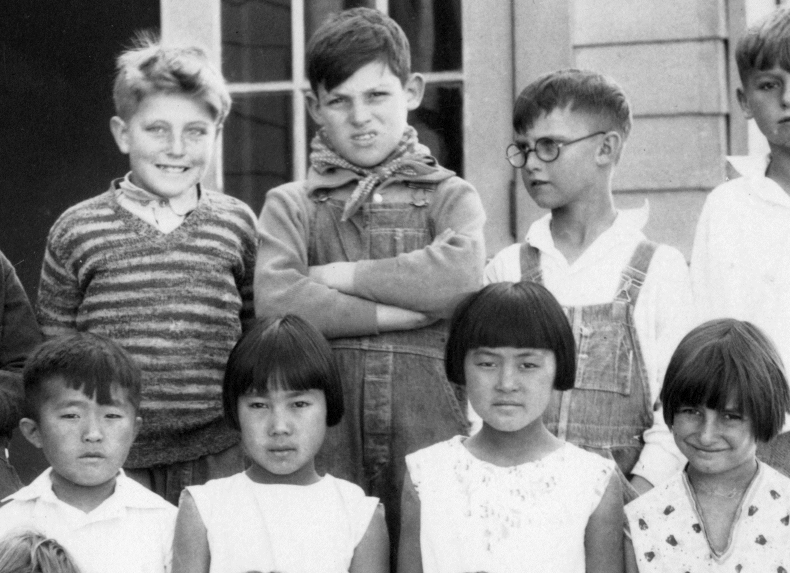
GRAMMAR SCHOOL DAYS: Farm children in the Smeltzer and Wintersburg Village areas (now both part of north Huntington Beach) attended the Ocean View Grammar School which was located at the southwest corner of Beach Boulevard and Warner Avenue (where the Comerica building stands today). Among the students in the photograph are children from the Furuta and Akiyama families, two of Wintersburg Village’s three goldfish farmers. You can almost feel the anxious excitement of the children in this photograph, ready for the end of the school day when they can run back through the rural countryside to home.
Learn about Huntington Beach's unique pioneer history!
Stop by the Main Street Library to see the full, original images from our pioneer settlement days! Learn more about Historic Wintersburg at our sister blog, http://historicwintersburg.blogspot.com/
© All rights reserved. No part of the Historic Huntington Beach blog may be reproduced or duplicated without prior written permission from the author and publisher, M. Adams Urashima.
Saturday, August 23, 2014
The National Trust for Historic Preservation visits Huntington Beach

In town to see Huntington Beach's Historic Wintersburg property---named this year as one of America's 11 Most Endangered Historic Places by the National Trust for Historic Preservation---a team from the National Trust also viewed some of the historic downtown. One of their stops was the M.E. Helme Furnishing Company and Worthy House (read about it at http://historichuntingtonbeach.blogspot.com/2012/08/historic-walking-tour-6-me-helme-house.html).
This is the first time ever in the 27-year history of the America's 11 Most Endangered Historic Places list that an Orange County historical site has been included. Historic Wintersburg is the only historic site named in the western continental United States, the majority on the list being east of the Mississippi. Also on the list are historic places such as Frank Lloyd Wright's Spring House in Tallahassee, Florida; The Palisades in New Jersey; the Union Terminal in Cincinnati, Ohio; and the Chattanooga State Office Building in Chattanooga, Tennessee.
Read about why Historic Wintersburg made the list here http://historicwintersburg.blogspot.com/2014/06/national-trust-announces-americas-11.html and about how preservation of Historic Wintersburg can transform a north Huntington Beach neighborhood here http://historicwintersburg.blogspot.com/2014/08/the-history-of-wintersburg-village.html

The endangered pioneer farm and mission property of Historic Wintersburg is bringing national and international attention and recognition to the rich history of Huntington Beach. A sampling of the regional and national media coverage:
Preservation Nation: http://blog.preservationnation.org/2014/02/19/race-save-japanese-american-history-historic-wintersburg-village/#.U_jhOWPnGXM
Smithsonian Magazine: http://www.smithsonianmag.com/travel/americas-most-endangered-historic-places-180951839/?utm_source=twitter.com&no-ist
Rafu Shimpo: http://www.rafu.com/2014/06/wintersburg-site-named-to-list-of-endangered-historic-places/
KPPC Southern California Public Radio: http://www.scpr.org/blogs/multiamerican/2014/07/18/17025/oc-japanese-american-most-endangered-wintersburg/
Aptly put by the National Trust, "This site has a much broader and much more uplifting story about building community, establishing your identity. The ultimate American immigrant story." An American story embodied by a Huntington Beach pioneer property. Help save Historic Wintersburg's historic goldfish farm and mission from demolition.

Join the effort to save Historic Wintersburg:
FACEBOOK https://www.facebook.com/pages/Historic-Wintersburg-Preservation-Task-Force/433990979985360
DONATE to the dedicated Historic Wintersburg Preservation Fund http://www.huntingtonbeachca.gov/i_want_to/give/donation-wintersburg.cfm
TWITTER @SurfCityWriter and @WintersburgHB
All rights reserved. No part of the Historic Huntington Beach blog may be reproduced or duplicated without prior written permission from the author and publisher, M. Adams Urashima.
Friday, November 1, 2013
Public television program to feature Huntington Beach family's pioneer history

We borrow from our sister blog, Historic Wintersburg, http://www.historicwintersburg.blogspot.com
to share an upcoming public television series that will feature another aspect of Huntington Beach history.
Discussions began in January 2013 with the new public television series, Our American Family, about the history of the Furuta family of Historic Wintersburg, now part of north Huntington Beach. The program producers were looking for a family whose story is iconic for Japanese Americans, from their earliest arrival in America in 1900 through their path to the present day.
The mission of Our American Family is "to document our American family heritage, one family at a time, and inspire viewers to capture their own family stories - before those voices are gone." The producers talked about their own families and the lessons we can learn from those who came before: "Every day that passes is another day closer to a day when we will no longer be able to hear first-hand what it meant to be a family during this simpler time, before the world changed. To hear first-hand what lessons were learned that we can apply today..."
.jpg)
In September 2013, filming began to capture the story of Charles Mitsuji and Yukiko Yajima Furuta, and their descendants. With the recorded 1982 oral history of Yukiko Furuta, the stories and memories of five generations of the Furuta family will be heard. The oral history interviews will include historic photographs and present-day images filmed on the Furuta farm and other places in Historic Huntington Beach.
Our American Family featuring the Furuta family will be aired in 2014 (date to be announced) on public television around the country. For readers of Historic Huntington Beach and Historic Wintersburg, a special preview from the program's producers.
SPECIAL PREVIEW: OUR AMERICAN FAMILY, THE FURUTA FAMILY of HUNTINGTON BEACH, CALIFORNIA
Note: This excerpt starts in 1912, the year Charles Furuta married Yukiko Yajima. Charles had lived in the United States for 12 years---arriving in 1900---and, had saved enough money to buy land and build a home in Wintersburg Village, now part of Huntington Beach. He donated land on his farm for the Wintersburg Mission.
Editor's note: For more information about sponsorship of the Our American Family program, please contact surfcitywriter@yahoo.com
All rights reserved. No part of the Historic Huntington Beach blog may be reproduced or duplicated without prior written permission from the author and publisher, M. Adams Urashima.
Subscribe to:
Comments (Atom)