Wednesday, September 2, 2015
Huntington Beach Historical Society's Civil War Days September 5 - 6
A gathering of Civil War veterans at the Methodist Campground in Huntington Beach, circa 1913. (Photograph courtesy of City of Huntington Beach archives)
Did you know the Grand Army of the Republic (GAR)---Civil War veterans from the North and South---camped at Huntington Beach beginning in 1887?
This was an annual multi-day reunion held at the end of August / start of September at the beach and Methodist campground near Acacia and Orange streets (where the century-old and recently restored Corner Market is today). Hundreds and sometimes thousands attended.
LEFT: The GAR encampment included military ceremonies, beach camp fires, musical entertainment and, at times, lively political debate. (Image, Los Angeles Herald, September 7 1905)
This weekend, 128 years later, the Huntington Beach Historical Society holds its annual Civil War Days with historical reenactment in Central Park. Representing a volatile period in America, historical reenactment of the Civil War provides an educational opportunity and a reminder of Huntington Beach's GAR history.
In the early 1900s, the Huntington Beach News reported on activities, flag drills, musical entertainment, plays, beach camp fires, ceremonies and trips via the Red Car into the Sawtelle Veterans Home in Los Angeles County (established in 1887).
LEFT: Cannons, bugles, flags and military attire filled the streets and beaches of Huntington Beach when the GAR came to town. (Photograph courtesy of City of Huntington Beach archives)
Except for an outbreak of ptomaine poisoning among 200 veterans after a big dinner in August 1910, they generally had a good time. There are some reports of arguments regarding the North and the South, which they resolved or agreed to disagree. As we know in 2015, this history remains a living part of the fabric of America.
LEFT: By 1910, the GAR encampment at Huntington Beach was in its 23 year (despite the typo in the newspaper headline). An outline of the week's activities includes a speech by the mayor of Huntington Beach and a formal goodbye handshake at the close. (Image, Los Angeles Herald, July 4, 1910)
This is a free event to the public in Huntington Beach's beautiful Central Park. More information can be found on the Huntington Beach Historical Society's website for this event at http://hbcivilwar.webs.com/
ABOVE: The Malvern Camp Hill Post at Huntington Beach, circa 1900. A news article of the time notes the veterans preferred their tents to other accommodations. The history of "tent cities" in Huntington Beach relates to the GAR, the oil boom (when housing could not keep pace), and to religious revivals. (Photograph courtesy of City of Huntington Beach archives)
© All rights reserved. No part of the Historic Huntington Beach blog may be reproduced or duplicated without prior written permission from the author and publisher, M. Adams Urashima.
Sunday, March 15, 2015
It's hanami time! Sister City 2nd annual Cherry Blossom Festival in Central Park
The first annual Cherry Blossom Festival in 2014 was perfectly timed with the blossoming of cherry trees from Huntington Beach's Sister City of Anjo, Japan. (Photograph courtesy of Gregory Robertson) © All rights reserved.
It's time for the Cherry Blossom Festival! Join the Huntington Beach Sister City Association Sunday, March 22, for the second annual Cherry Blossom Festival, 10:30 a.m. to 4 p.m., in Central Park at the grandstand area behind the Huntington Beach Central Library.
Left: Monument stone in Central Park recognizing the gift of cherry trees from Sister City Anjo, Japan.
A tradition adopted from Huntington Beach's Sister City of Anjo, Japan---who presented the cherry trees as a gift to the City---the tradition of "flower viewing" is called hanami.
Most often, hanami festivals and picnics are centered around the sakura, or cherry blossoms. The hanami is a tradition known to have occurred at least as early as the 3rd Century A.D. It is deeply embedded in Japanese culture, a time for friends and family to gather outdoors, welcome spring, and socialize.
The U.S. National Cherry Blossom Festival began March 27, 1912, with the planting of cherry trees by First Lady Helen Taft and Viscountess Chinda, wife of the Japanese ambassador. Japan presented as a gift of friendship more than 3,000 trees, come of which were planted on the grounds of the White House.
As more trees were planted in the Potomac Park, the annual spring blossoming evolved into the first National Cherry Blossom Festival in 1935, which has since become a beloved tradition in Washington, D.C.
Right: A stone lantern and stones presented to the City of Huntington Beach by Anjo, Japan, circa 1982. (Photograph by M.Urashima, February 2015) © All rights reserved.
The National Cherry Blossom Festival is opened by the lighting of a 300-year-old Japanese Stone Lantern that was a gift from Japan in 1954, recognizing the 100th anniversary of the first Treaty of Peace, Amity and Commerce between the United States and Japan on March 31, 1854.
Right: Cherry trees blossoming in Huntington Beach Central Park. (Photograph by M. Urashima, March 9, 2015) © All rights reserved.
Forecasting the dates on which cherry trees will be in full bloom is high science in Japan. The Japan Meteorological Agency track the cherry blossom "front" as it moves from southern to northern Japan, which is then reported by every news outlet.
We can report the cherry trees in Huntington Beach Central Park are now in bloom, perfectly timed with the Sister City Association's hanami so that locals and visitors can experience the "pink clouds."
Left: Taiko drummers performing at the 2014 Cherry Blossom Festival in Huntington Beach Central Park. (Photograph by M. Urashima, March 29, 2014) © All rights reserved.
The Huntington Beach Cherry Blossom Festival features live dance and theater performances, music, local organizations relating to both Japanese and Japanese American culture and history.
The festival also features a variety of savories and sweets to try. In keeping with a humorous Japanese proverb, "dumplings before flowers," check out some delicious Japanese cuisine and cool off with shave ice, a local favorite.
Cherry blossoms have various symbolic meanings in Japanese culture, but often are seen as a metaphor for the fragility and transience of life. A beautiful reminder to take time to view the cherry blossoms!
© All rights reserved. No part of the Historic Huntington Beach blog may be reproduced or duplicated without prior written permission from the author and publisher, M. Adams Urashima.
without regret
they fall and scatter
cherry blossoms
~Issa, a haiku written in 1821
It's time for the Cherry Blossom Festival! Join the Huntington Beach Sister City Association Sunday, March 22, for the second annual Cherry Blossom Festival, 10:30 a.m. to 4 p.m., in Central Park at the grandstand area behind the Huntington Beach Central Library.
Left: Monument stone in Central Park recognizing the gift of cherry trees from Sister City Anjo, Japan.
A tradition adopted from Huntington Beach's Sister City of Anjo, Japan---who presented the cherry trees as a gift to the City---the tradition of "flower viewing" is called hanami.
Most often, hanami festivals and picnics are centered around the sakura, or cherry blossoms. The hanami is a tradition known to have occurred at least as early as the 3rd Century A.D. It is deeply embedded in Japanese culture, a time for friends and family to gather outdoors, welcome spring, and socialize.
The U.S. National Cherry Blossom Festival began March 27, 1912, with the planting of cherry trees by First Lady Helen Taft and Viscountess Chinda, wife of the Japanese ambassador. Japan presented as a gift of friendship more than 3,000 trees, come of which were planted on the grounds of the White House.
As more trees were planted in the Potomac Park, the annual spring blossoming evolved into the first National Cherry Blossom Festival in 1935, which has since become a beloved tradition in Washington, D.C.
Right: A stone lantern and stones presented to the City of Huntington Beach by Anjo, Japan, circa 1982. (Photograph by M.Urashima, February 2015) © All rights reserved.
The National Cherry Blossom Festival is opened by the lighting of a 300-year-old Japanese Stone Lantern that was a gift from Japan in 1954, recognizing the 100th anniversary of the first Treaty of Peace, Amity and Commerce between the United States and Japan on March 31, 1854.
Right: Cherry trees blossoming in Huntington Beach Central Park. (Photograph by M. Urashima, March 9, 2015) © All rights reserved.
Forecasting the dates on which cherry trees will be in full bloom is high science in Japan. The Japan Meteorological Agency track the cherry blossom "front" as it moves from southern to northern Japan, which is then reported by every news outlet.
We can report the cherry trees in Huntington Beach Central Park are now in bloom, perfectly timed with the Sister City Association's hanami so that locals and visitors can experience the "pink clouds."
Left: Taiko drummers performing at the 2014 Cherry Blossom Festival in Huntington Beach Central Park. (Photograph by M. Urashima, March 29, 2014) © All rights reserved.
The Huntington Beach Cherry Blossom Festival features live dance and theater performances, music, local organizations relating to both Japanese and Japanese American culture and history.
The festival also features a variety of savories and sweets to try. In keeping with a humorous Japanese proverb, "dumplings before flowers," check out some delicious Japanese cuisine and cool off with shave ice, a local favorite.
Cherry blossoms have various symbolic meanings in Japanese culture, but often are seen as a metaphor for the fragility and transience of life. A beautiful reminder to take time to view the cherry blossoms!
© All rights reserved. No part of the Historic Huntington Beach blog may be reproduced or duplicated without prior written permission from the author and publisher, M. Adams Urashima.
Sunday, February 22, 2015
Saturday, February 14, 2015
ADVANCE SCREENING: Huntington Beach pioneer story comes to PBS SoCal
From our sister blog, Historic Wintersburg in Huntington Beach, the history of the Furuta family of Wintersburg Village comes to PBS in 2015.
The screening will be held in the Tateuchi Democracy Forum theater at the Museum, which is located in the historic district of Little Tokyo. Parking is available at the Little Tokyo Mall on 1st Street and at the John Aiso Street parking facility, between 1st and Temple streets.
In the early 1900s, the Pacific Electric Railway, also known as the "Red Car," had a line between Huntington Beach and Little Tokyo. Visitors are encouraged to stop for mochi and other sweets at the Fugetsu-do confectionery in Little Tokyo on 1st Street, where Yukiko Furuta shopped a century ago, http://www.fugetsu-do.com/
Historic Wintersburg is proud to have provided background, research and assistance with the film production, featuring five-generations of oral histories, archival photographs and interviews with the Furuta family. The history begins with Charles Furuta's arrival in America in 1900 and his effort to establish a new life in what is now Huntington Beach.
As featured in this post on the Historic Wintersburg blog, http://historicwintersburg.blogspot.com/2013/10/our-american-family-features-furuta.html, the filming in Southern California was in September 2013 (see preview video at that link). At the same time, the book, Historic Wintersburg in Huntington Beach, was in final review by the publisher, History Press.
Left: The book, Historic Wintersburg in Huntington Beach (History Press) was published in March 2014. The book shares the history of the Furuta family, Orange County's Japanese pioneers, and the origins of Wintersburg Village, which was annexed into Huntington Beach in 1957.
In addition to the 1982 oral history of Yukiko Furuta, film makers utilized research, oral histories, and images provided by the author of Historic Wintersburg in Huntington Beach, historian Mary Adams Urashima, the California State University Fullerton Center for Oral and Public History, one-on-one interviews with Furuta family descendants, and personal photographs from the Furuta family.
The screening of Our American Family: The Furutas starts at 5 p.m. in the Takeuchi Democracy Forum theater, across the plaza from the Museum's main entrance. This is a free advanced screening, open to the public. Seating is limited.
RIGHT: Etsuko Furuta (second row, third from right) in her third grade class at Ocean View Grammar School, 1929. The Ocean View Grammar School was at the southwest corner of Beach Boulevard and Warner Avenue (then Wintersburg Avenue). These students later attended Huntington Beach High School. This photograph is in the exhibit currently on display at the Main Street Library in Huntington Beach, 525 Main Street. (Photo courtesy of the Furuta family) © All rights reserved.
We thank PBS SoCal for assisting with the advance screening in Southern California. PBS SoCal is the first PBS station in the country to air Our American Family: The Furutas, with air dates starting in late February 2015 and early March 2015 following the advanced screening. Later this year, PBS stations around the country will begin airing the program in May (contact your local PBS station for dates and times).
ABOVE: A photograph by Charles Furuta of beach goers at Huntington Beach, circa 1913. (Photo courtesy of the Furuta family) © All rights reserved.
More information about Historic Wintersburg in Huntington Beach and Our American Family: The Furutas at http://historicwintersburg.blogspot.com/2015/01/advance-screening-our-american-family.html
Information and directions for the Japanese American National Museum at http://www.janm.org/ Signed copies of Historic Wintersburg in Huntington Beach are available in the Museum gift shop.
© All rights reserved. No part of the Historic Huntington Beach blog may be reproduced or duplicated without prior written permission from the author and publisher, M. Adams Urashima.
Thursday, December 11, 2014
Pacific City: Our first City Hall
ABOVE: Pacific City Hall remains standing today at 122 Main Street, in its new life as Mangiamo's Gelato Caffe. It was a cash grocery and feed store on the lower level, with the town governance meetings held upstairs. This photograph is from a booster flyer entitled, "Homes with Pleasure and Business," circa 1904, which included the new Pacific Electric Railway station near the Huntington Beach pier and Ocean Avenue (now Pacific Coast Highway). Sanborn fire insurance maps document the building at this site in 1909, while the Historic Resources Assessment report by PCR Services Corporation dates the building to this location in 1902. Research by the City Historic Resources Board, with assistance from the Orange County Archives, documents the building was at 122 Main Street in 1901, placed there by Pacific City founder Philip Stanton. (Photograph courtesy of the Helme Worthy Collection) © All rights reserved.
Updated January 29, 2015 - On January 20, 2015, the Huntington Beach City Council voted 4-3 to approve the environmental report and demolition of the majority of the Pacific City Hall building. The action requires the property owner to move their structure back six feet, with an attempt to save the facade on the building as an architectural treatment for a new four-story building.
The picture worth a thousand words is above. And, the question about whether or not 122 Main Street was our first City Hall has been answered. It's right there, painted on top of the wooden pioneer building, right above the grocery and feed store.
A "filler" advertisement for Pacific City in the 1903 Orange County Directory. (Image, Fullerton Public Library)
This is where pioneer business was conducted, perhaps the first discussions about how to get Henry Huntington to bring the Pacific Electric Railway to town. Pioneer leaders might have sat on the hanging balcony to survey the comings and goings on Main Street, smoking their cigars and making big plans. Or, more likely, anxiously wondering if this dusty little seaside village was going to succeed and how on earth could they attract investment.
This first seat of city government is now living large more than a century later serving up Italian ice in Mangiamo's Gelato Caffe, something pioneers probably would have loved in ice box days.
LEFT: Peek in the back of 122 and 124 Main Street to find 122's original hardwood batten board in remarkably pristine condition (to the left). An early 1900s storm drain solution runs the gap between the buildings. The original corrugated tin siding from 1910 can be seen on 124 Main Street, now a souvenir shop.(Photo, December 2014) © All rights reserved.
In ironic timing, the question of the building's history and fate comes at a time when the "new" Pacific City* is taking shape along Pacific Coast Highway, more than a century after the original Pacific City was dreamed up in 1901. This sturdy little building has a story to tell.
ABOVE: A bit neglected on the alley side, a doorway to the second floor once had an outside stairway, direct to Pacific City Hall meeting rooms. This is an easy preservation fix, considering the hardwood construction. (Photo, December 2014) © All rights reserved.
Pacific City
The City of Huntington Beach Historic Resources Board (HRB) explained at a recent planning commission meeting the significance of 122 and its neighbor, 124 Main Street, which "critically document the commercial development of Huntington Beach. These lots were originally surveyed as Lots 22 and 24 of Block 5 of Pacific City dating back to our city's infancy. This, combined with the paucity of commercial buildings in the first decade of the 20th Century, reinforce the probability that 122 Main Street housed the early City Hall. Certainly, it is among the earliest structures on Main Street."
ABOVE: Main Street prior to the 1909 incorporation of Huntington Beach, in 1907. The distinctive balcony of 122 Main Street can be seen on the south side of the dusty, unpaved road. (Photo, City of Huntington Beach archives)
HRB member and historian Kathie Schey further detailed in a supplemental letter to the planning commission, "the evidence for this conclusion has stemmed from the recollections of Mr. Bud Higgins. Higgins, an early resident of Huntington Beach was certainly in a position to know. Not only had he lived in the city for many years but he had known others who had been alive at the time of the city's creation who had first-hand knowledge of those earliest years."
"Further, there was no reason to embellish this information since there was no threat to this structure at that time and no reason to inflate its importance," Schey explains. "Far from simple 'hearsay' this evidence is important to oral history, a type of resource widely recognized by historians today."
Delbert "Bud" Higgins was one of Huntington Beach's first surfboard shapers (he had met Duke Kahanamoku in the 1920s), first lifeguards, and also its first fire chief. His oral and personal historical accounts of Huntington Beach history are retained at California State University Fullerton, Center for Oral and Public History.
A snip from the Los Angeles Times article, 'Shrine' a Target for Condemnation, from December 1989, indicates the Pacific City Hall survived an earlier demolition threat. The article references the building had been the first city hall with a quote from Charles Sarrabere, whose pioneer family owned the building for over six decades. (Image, Los Angeles Times, December 5, 1989)
Schey further documented that, "In his memoirs, My Sixty Years in California, Huntington Beach pioneer Tom Talbert notes the first city post office was located on Main Street "where Sarrabere's have their cleaning shop (122 Main St.)"
Talbert , one of Huntington Beach's early mayors, published his book in 1952. The Sarrabere family's 65-year ownership of the building began in 1916, with Charles Sarrabere running the family's cleaning business there until 1981.
In the late 1980s, the City of Huntington Beach pursued acquisition of 122 and 124 Main Street under California redevelopment law, "authorizing the acquisition of such property by eminent domain" for development purposes of what was known as the "Main-Pier Redevelopment Project Area." Many of the structures noted as contributors to the historic district were on the list for acquisition.
A July 1990 letter from the Huntington Beach Historic Resources Board to the Planning Commission included this list, noting 122 Main Street was "Pacific City City Hall." The letter was signed by Jerry Person, the present-day historian for Huntington Beach. Note, the Historic Wintersburg property on Warner Avenue in Huntington Beach also is on this list, listed as "Japanese Church Buildings." (Image, City of Huntington Beach archives)
More than one Sarrabere family property was proposed for acquisition, including the property that was the family residence on Pacific Coast Highway, south of Main Street. Charles Sarrabere sent a letter to the City registering his opposition, stating his family's long land ownership in Huntington Beach. When interviewed by the Los Angeles Times in 1989, Sarrabere, then 78, commented about 122 Main Street that, "I was practically raised there."
Local businessman and then member of the City of Huntington Beach Historic Resources Board, Douglas Langevin, told the Los Angeles Times in 1989 the building was "one of the very few of the original wood structures left in the city...In my view, that is the most important (of the old wooden buildings) given its history with the city." Langevin faced opposition from the city council when he went about restoring another wooden pioneer structure: the 1904 Talbert-Leatherman building at 217 Main Street, now the Longboard Restaurant and Pub.
ABOVE: A closer look at Pacific City Hall, a center of community activity with the market below and the barber next door. Both 122 and 124 Main Street were included in a map sent by the California State Office of Historic Preservation to the City of Huntington Beach in 1988, outlining the downtown structures they believed contributed to a historic district that would qualify for the National Register of Historic Places. (Photograph snip courtesy of the Helme Worthy Collection) © All rights reserved.
Then, the photograph appeared, courtesy of the Helme Worthy Collection,** with "Pacific City Hall" painted in large letters on the building's Western False Front facade, further confirming its history. This is where the founding fathers of Huntington Beach dreamed up a resort town with a pleasure pier and "Red Car" train. How much we owe that little building, which has survived the 1933 earthquake, the ups and downs of the last century's economy, and the 1980s redevelopment era that removed many of its brothers.
Nevertheless, the building's important civic history was misplaced over the years, while half of the community's historic structures were lost to development.***
This is how we lose things. Time fades community memory, as documents and historical photographs are lost. Ultimately, pioneer roots are removed and the sense of place is altered. Then, people pay to have the history they miss "re-created."
But, it's not the same. New buildings weren't touched by earlier generations. They don't tell the authentic story of horse-drawn wagons, land baron schemes, the oil boom wildcats, the lean Depression years, two world wars, and the earthquakes and floods that made Californians more resilient. For more than a hundred years, 122 an 124 Main Street shared our journey, from the settlement of Huntington Beach into the 21st Century as Surf City.
ABOVE: The corrugated siding on 124 Main Street likely dates back to 1910 when the building was constructed, just after the incorporation of Huntington Beach in 1909. The building originally was the Tripp Market, then the location of O'Barrs Drugstore in 1914. After that, it became the U.S. Restaurant (1919), the Huntington Beach Stock Exchange, Fowler's Paint, the Buckhorn Cafe (1939), and the 20/30 Cafe (1943). (Photo, December 2014) © All rights reserved.
The fate of 122 and 124 Main Street, will go before the Huntington Beach city council soon. The original Western False Front facade with hand-painted sign on 122 Main Street is believed to be under the facade added in the 1920s; covering over building materials was the practice of the day when materials were scarce.
As the historical consultant, PCR Services Corporation, notes: "The false front commercial building type is an icon of the urban pioneer West. When movie directors or theme park designers erect a typical western town, the false front commercial building usually plays a prominent role. Unlike many myths of the West, the false front commercial building truly was a common sight in Colorado as well as California."
"For a developing town in the early 20th Century, like Huntington Beach, the false front commercial building was an economical solution," further explains the historical consultant. "Sound business economics led commercial building owners to budget their spending for substantial facades while relegating the secondary sides of buildings to a cheaper utilitarian treatment."
PCR Services later explains "fire often swept through early commercial districts, eliminating most of the wood western false front buildings." How lucky we are that 122 Main Street survived. Even the later embellishment of the fancy Western False Front facade---telling the story of pioneer business practices in a developing town---is now nearing the century mark.
The history is undeniable. But, history repeats and some of our history is the removal of historic places from our landscape. On December 1, people gathered to watch the unveiling of a plaque for the Golden Bear, another important icon of Huntington Beach history lost to 1980s redevelopment. The looming question now is what can be done to save the very beginnings of Pacific City and Huntington Beach.
ABOVE: Main Street in 1906, looking from the second block west toward the Pacific Ocean and the pier. The balcony of Pacific City Hall can be seen on the south side of the street. (Photo snip, City of Huntington Beach archives)
"It is extremely clear that these two buildings, born with our city, have stood mute witness to our city’s growth and historic legacy," explained the HRB in their November 26 letter to the planning commission. "Closely surrounding structures that may also have remained to celebrate even some portion of this past are long gone. Even the adjacent Standard Market, which replaced an earlier structure when it began operations as early as 1926, is gone today. This loss of most of the historic fabric of the downtown area has been tragic."
These are not just buildings any more, remarked a planning commissioner after seeing the photograph, "It's now a place."
MORE THAN A CENTURY OLD: 124 (circa 1910) and 122 (circa 1902) Main Street, two of the handful of pioneer structures left in downtown Huntington Beach. (Photo, December 2014) © All rights reserved.
*Learn about Huntington Beach's "new" Pacific City at http://gopacificcity.com/
**The Helme Worthy Collection is held by Susie Worthy--the great grandaughter of pioneer and early mayor Matthew Helme--and her husband, Guy Guzzardo. They currently are restoring the M.E. Helme House Furnishing Co. and Worthy House in the historic downtown on Walnut Avenue, which is listed on the National Register of Historic Places. Read more about the Helme-Worthy buildings at http://historichuntingtonbeach.blogspot.com/2012/08/historic-walking-tour-6-me-helme-house.html
***Over half the properties noted in a 1986 survey of the city's historic resources have been lost to demolition and development. An update initiated in 2009 is pending review by the city council in 2015.
READ the Huntington Beach Independent article about the discussion at the December 9, 2014, planning commission meeting: http://www.hbindependent.com/news/tn-hbi-me-1211-planning-20141210,0,2345434.story
Frequently Asked Question: What makes a property historic?
AGE - A property must be at least 50 years old as a general rule of thumb, but, not always if there has been a significant event or person associated with the place. It must be old enough to have been studied by historians, architectural historians, or archaeologists regarding its place in history. Both 122 and 124 Main Street have been studied, as part of the 1986 historic resources survey almost 30 years ago, and by the State Office of Historic Preservation as part of their recommendation for a downtown historic district in 1988.
INTEGRITY - In addition to age, a property should retain its historic physical integrity. For a building, structure, landscape feature, historic site, or historic district, this means the property is relatively unchanged. Some alterations made 50+ years ago can be considered part of the history, reflecting certain time periods.
SIGNIFICANCE - A property can be defined as significant in three ways: 1) direct association with individuals, events, activities, or developments that shaped history or reflect important aspects of history; 2) by embodying the distinctive physical and spatial characteristics of an architectural style or type, method of construction, or craftsmanship; 3) having the potential to yield information important to our understanding of the past.
© All rights reserved. No part of the Historic Huntington Beach blog may be reproduced or duplicated without prior written permission from the author and publisher, M. Adams Urashima.
Updated January 29, 2015 - On January 20, 2015, the Huntington Beach City Council voted 4-3 to approve the environmental report and demolition of the majority of the Pacific City Hall building. The action requires the property owner to move their structure back six feet, with an attempt to save the facade on the building as an architectural treatment for a new four-story building.
The picture worth a thousand words is above. And, the question about whether or not 122 Main Street was our first City Hall has been answered. It's right there, painted on top of the wooden pioneer building, right above the grocery and feed store.
A "filler" advertisement for Pacific City in the 1903 Orange County Directory. (Image, Fullerton Public Library)
This is where pioneer business was conducted, perhaps the first discussions about how to get Henry Huntington to bring the Pacific Electric Railway to town. Pioneer leaders might have sat on the hanging balcony to survey the comings and goings on Main Street, smoking their cigars and making big plans. Or, more likely, anxiously wondering if this dusty little seaside village was going to succeed and how on earth could they attract investment.
This first seat of city government is now living large more than a century later serving up Italian ice in Mangiamo's Gelato Caffe, something pioneers probably would have loved in ice box days.
LEFT: Peek in the back of 122 and 124 Main Street to find 122's original hardwood batten board in remarkably pristine condition (to the left). An early 1900s storm drain solution runs the gap between the buildings. The original corrugated tin siding from 1910 can be seen on 124 Main Street, now a souvenir shop.(Photo, December 2014) © All rights reserved.
In ironic timing, the question of the building's history and fate comes at a time when the "new" Pacific City* is taking shape along Pacific Coast Highway, more than a century after the original Pacific City was dreamed up in 1901. This sturdy little building has a story to tell.
ABOVE: A bit neglected on the alley side, a doorway to the second floor once had an outside stairway, direct to Pacific City Hall meeting rooms. This is an easy preservation fix, considering the hardwood construction. (Photo, December 2014) © All rights reserved.
Pacific City
The City of Huntington Beach Historic Resources Board (HRB) explained at a recent planning commission meeting the significance of 122 and its neighbor, 124 Main Street, which "critically document the commercial development of Huntington Beach. These lots were originally surveyed as Lots 22 and 24 of Block 5 of Pacific City dating back to our city's infancy. This, combined with the paucity of commercial buildings in the first decade of the 20th Century, reinforce the probability that 122 Main Street housed the early City Hall. Certainly, it is among the earliest structures on Main Street."
ABOVE: Main Street prior to the 1909 incorporation of Huntington Beach, in 1907. The distinctive balcony of 122 Main Street can be seen on the south side of the dusty, unpaved road. (Photo, City of Huntington Beach archives)
HRB member and historian Kathie Schey further detailed in a supplemental letter to the planning commission, "the evidence for this conclusion has stemmed from the recollections of Mr. Bud Higgins. Higgins, an early resident of Huntington Beach was certainly in a position to know. Not only had he lived in the city for many years but he had known others who had been alive at the time of the city's creation who had first-hand knowledge of those earliest years."
"Further, there was no reason to embellish this information since there was no threat to this structure at that time and no reason to inflate its importance," Schey explains. "Far from simple 'hearsay' this evidence is important to oral history, a type of resource widely recognized by historians today."
Delbert "Bud" Higgins was one of Huntington Beach's first surfboard shapers (he had met Duke Kahanamoku in the 1920s), first lifeguards, and also its first fire chief. His oral and personal historical accounts of Huntington Beach history are retained at California State University Fullerton, Center for Oral and Public History.
A snip from the Los Angeles Times article, 'Shrine' a Target for Condemnation, from December 1989, indicates the Pacific City Hall survived an earlier demolition threat. The article references the building had been the first city hall with a quote from Charles Sarrabere, whose pioneer family owned the building for over six decades. (Image, Los Angeles Times, December 5, 1989)
Schey further documented that, "In his memoirs, My Sixty Years in California, Huntington Beach pioneer Tom Talbert notes the first city post office was located on Main Street "where Sarrabere's have their cleaning shop (122 Main St.)"
Talbert , one of Huntington Beach's early mayors, published his book in 1952. The Sarrabere family's 65-year ownership of the building began in 1916, with Charles Sarrabere running the family's cleaning business there until 1981.
In the late 1980s, the City of Huntington Beach pursued acquisition of 122 and 124 Main Street under California redevelopment law, "authorizing the acquisition of such property by eminent domain" for development purposes of what was known as the "Main-Pier Redevelopment Project Area." Many of the structures noted as contributors to the historic district were on the list for acquisition.
A July 1990 letter from the Huntington Beach Historic Resources Board to the Planning Commission included this list, noting 122 Main Street was "Pacific City City Hall." The letter was signed by Jerry Person, the present-day historian for Huntington Beach. Note, the Historic Wintersburg property on Warner Avenue in Huntington Beach also is on this list, listed as "Japanese Church Buildings." (Image, City of Huntington Beach archives)
More than one Sarrabere family property was proposed for acquisition, including the property that was the family residence on Pacific Coast Highway, south of Main Street. Charles Sarrabere sent a letter to the City registering his opposition, stating his family's long land ownership in Huntington Beach. When interviewed by the Los Angeles Times in 1989, Sarrabere, then 78, commented about 122 Main Street that, "I was practically raised there."
Local businessman and then member of the City of Huntington Beach Historic Resources Board, Douglas Langevin, told the Los Angeles Times in 1989 the building was "one of the very few of the original wood structures left in the city...In my view, that is the most important (of the old wooden buildings) given its history with the city." Langevin faced opposition from the city council when he went about restoring another wooden pioneer structure: the 1904 Talbert-Leatherman building at 217 Main Street, now the Longboard Restaurant and Pub.
ABOVE: A closer look at Pacific City Hall, a center of community activity with the market below and the barber next door. Both 122 and 124 Main Street were included in a map sent by the California State Office of Historic Preservation to the City of Huntington Beach in 1988, outlining the downtown structures they believed contributed to a historic district that would qualify for the National Register of Historic Places. (Photograph snip courtesy of the Helme Worthy Collection) © All rights reserved.
Then, the photograph appeared, courtesy of the Helme Worthy Collection,** with "Pacific City Hall" painted in large letters on the building's Western False Front facade, further confirming its history. This is where the founding fathers of Huntington Beach dreamed up a resort town with a pleasure pier and "Red Car" train. How much we owe that little building, which has survived the 1933 earthquake, the ups and downs of the last century's economy, and the 1980s redevelopment era that removed many of its brothers.
Nevertheless, the building's important civic history was misplaced over the years, while half of the community's historic structures were lost to development.***
This is how we lose things. Time fades community memory, as documents and historical photographs are lost. Ultimately, pioneer roots are removed and the sense of place is altered. Then, people pay to have the history they miss "re-created."
But, it's not the same. New buildings weren't touched by earlier generations. They don't tell the authentic story of horse-drawn wagons, land baron schemes, the oil boom wildcats, the lean Depression years, two world wars, and the earthquakes and floods that made Californians more resilient. For more than a hundred years, 122 an 124 Main Street shared our journey, from the settlement of Huntington Beach into the 21st Century as Surf City.
ABOVE: The corrugated siding on 124 Main Street likely dates back to 1910 when the building was constructed, just after the incorporation of Huntington Beach in 1909. The building originally was the Tripp Market, then the location of O'Barrs Drugstore in 1914. After that, it became the U.S. Restaurant (1919), the Huntington Beach Stock Exchange, Fowler's Paint, the Buckhorn Cafe (1939), and the 20/30 Cafe (1943). (Photo, December 2014) © All rights reserved.
The fate of 122 and 124 Main Street, will go before the Huntington Beach city council soon. The original Western False Front facade with hand-painted sign on 122 Main Street is believed to be under the facade added in the 1920s; covering over building materials was the practice of the day when materials were scarce.
As the historical consultant, PCR Services Corporation, notes: "The false front commercial building type is an icon of the urban pioneer West. When movie directors or theme park designers erect a typical western town, the false front commercial building usually plays a prominent role. Unlike many myths of the West, the false front commercial building truly was a common sight in Colorado as well as California."
"For a developing town in the early 20th Century, like Huntington Beach, the false front commercial building was an economical solution," further explains the historical consultant. "Sound business economics led commercial building owners to budget their spending for substantial facades while relegating the secondary sides of buildings to a cheaper utilitarian treatment."
PCR Services later explains "fire often swept through early commercial districts, eliminating most of the wood western false front buildings." How lucky we are that 122 Main Street survived. Even the later embellishment of the fancy Western False Front facade---telling the story of pioneer business practices in a developing town---is now nearing the century mark.
The history is undeniable. But, history repeats and some of our history is the removal of historic places from our landscape. On December 1, people gathered to watch the unveiling of a plaque for the Golden Bear, another important icon of Huntington Beach history lost to 1980s redevelopment. The looming question now is what can be done to save the very beginnings of Pacific City and Huntington Beach.
ABOVE: Main Street in 1906, looking from the second block west toward the Pacific Ocean and the pier. The balcony of Pacific City Hall can be seen on the south side of the street. (Photo snip, City of Huntington Beach archives)
"It is extremely clear that these two buildings, born with our city, have stood mute witness to our city’s growth and historic legacy," explained the HRB in their November 26 letter to the planning commission. "Closely surrounding structures that may also have remained to celebrate even some portion of this past are long gone. Even the adjacent Standard Market, which replaced an earlier structure when it began operations as early as 1926, is gone today. This loss of most of the historic fabric of the downtown area has been tragic."
These are not just buildings any more, remarked a planning commissioner after seeing the photograph, "It's now a place."
MORE THAN A CENTURY OLD: 124 (circa 1910) and 122 (circa 1902) Main Street, two of the handful of pioneer structures left in downtown Huntington Beach. (Photo, December 2014) © All rights reserved.
*Learn about Huntington Beach's "new" Pacific City at http://gopacificcity.com/
**The Helme Worthy Collection is held by Susie Worthy--the great grandaughter of pioneer and early mayor Matthew Helme--and her husband, Guy Guzzardo. They currently are restoring the M.E. Helme House Furnishing Co. and Worthy House in the historic downtown on Walnut Avenue, which is listed on the National Register of Historic Places. Read more about the Helme-Worthy buildings at http://historichuntingtonbeach.blogspot.com/2012/08/historic-walking-tour-6-me-helme-house.html
***Over half the properties noted in a 1986 survey of the city's historic resources have been lost to demolition and development. An update initiated in 2009 is pending review by the city council in 2015.
READ the Huntington Beach Independent article about the discussion at the December 9, 2014, planning commission meeting: http://www.hbindependent.com/news/tn-hbi-me-1211-planning-20141210,0,2345434.story
Frequently Asked Question: What makes a property historic?
AGE - A property must be at least 50 years old as a general rule of thumb, but, not always if there has been a significant event or person associated with the place. It must be old enough to have been studied by historians, architectural historians, or archaeologists regarding its place in history. Both 122 and 124 Main Street have been studied, as part of the 1986 historic resources survey almost 30 years ago, and by the State Office of Historic Preservation as part of their recommendation for a downtown historic district in 1988.
INTEGRITY - In addition to age, a property should retain its historic physical integrity. For a building, structure, landscape feature, historic site, or historic district, this means the property is relatively unchanged. Some alterations made 50+ years ago can be considered part of the history, reflecting certain time periods.
SIGNIFICANCE - A property can be defined as significant in three ways: 1) direct association with individuals, events, activities, or developments that shaped history or reflect important aspects of history; 2) by embodying the distinctive physical and spatial characteristics of an architectural style or type, method of construction, or craftsmanship; 3) having the potential to yield information important to our understanding of the past.
© All rights reserved. No part of the Historic Huntington Beach blog may be reproduced or duplicated without prior written permission from the author and publisher, M. Adams Urashima.
Wednesday, December 3, 2014
Holidays in Huntington Beach, 1914
Celebrate the holidays, pioneer style, with the Huntington Beach Historical Society and Historic Wintersburg in Huntington Beach! More event details on our sister blog, Historic Wintersburg, at http://historicwintersburg.blogspot.com/2014/11/event-holidays-in-huntington-beach-1914.html
Saturday, October 11, 2014
New historical photography displayed at Huntington Beach's Main Street Library
ABOVE: Enter the main reading room at the Main Street Library and look up! An exhibit of historical images from Historic Wintersburg in Huntington Beach grace the walls. Informational materials are at the front counter. (Photo, October 2014)
It's only fitting that the Main Street Library---listed along with Triangle Park on the National Register for Historic Places in fall 2013---host historical photography exhibits that share the story of Huntington Beach.
The third in a series of exhibits---organized by the Huntington Beach Historic Resources Board---was just installed, featuring images from the Wintersburg Village (AKA Historic Wintersburg). The Wintersburg Village---which began forming in the late 1800s---was a distinct population center from the Huntington Beach Township on early U.S. Census records. It was annexed into Huntington Beach in 1957, but was connected with Huntington Beach commerce, civic events and daily life from the beginning.
ON THE NATIONAL REGISTER - The Huntington Beach historical photography exhibit is at the Main Street Library, 525 Main Street, on Triangle Park. Both the mid-Century modern Library and Triangle Park were placed on the National Register of Historic Places in fall, 2013, after an effort by local residents. Look for the grandfather clock inside, crafted by the Huntington Beach High School class of 1915.
The photography exhibit images reveal shared history with the pioneer settlement era of Huntington Beach.
Historic Wintersburg was named in June 2014 as one of America's 11 Most Endangered Historic Places by the National Trust for Historic Preservation. There is a current effort to save the six historic structures and 4 1/2-acre property from demolition, which could occur as early as May 2015. It is the only historical place of its type in California.
INSPIRED - The images of Historic Wintersburg have caught the imagination of many across the country. This painting is the work of Phoenix artist, Julie Cox, inspired after reading the the blog and book, Historic Wintersburg in Huntington Beach. (Image courtesy of Julie Cox, Phoenix, Arizona, 2014) © All rights reserved.
Here's what you'll view:
A BUNGALOW IN WINTERSBURG: Yukiko Furuta, standing on the steps of her new home in Wintersburg Village in 1913, facing what was then the muddy country road that was Wintersburg Avenue (now, a paved, multi-lane Warner Avenue). This bungalow---with its original red iron oxide paint and sharp, white trim---is one of six historic structures still standing at Historic Wintersburg.
FOUNDING FATHER - At left, a snip of the full image in the exhibit, taken on the steps of the Huntington Inn, May 1912. The exhibit photograph shows Huntington Beach's first mayor, Ed Manning, among a crowd that included four of Huntington Beach's first mayors, along with goldfish farmer Charles Furuta and a founder of the Wintersburg Mission, Reverend Hisakichi Terasawa. (Photo courtesy of the Furuta family) © All rights reserved.
CROWDFUNDING FOR THE PIER, VERSION 1912: On the steps of the Huntington Inn in 1912, leaders from Wintersburg Village’s Japanese American community and the Huntington Beach township leadership, standing together. In the photograph are four of Huntington Beach's first mayors: Ed Manning, Matthew Helme, Thomas Talbert and Eugene French (front and center). Historic Wintersburg's Charles Furuta is standing at the front left row below the first step. It is believed this meeting was about fundraising to rebuild the Huntington Beach pier, which had just been blown down by a Pacific storm. When the pier was rededicated in 1914, the Japanese community was prominently featured in the celebrations right after a surfing demonstration by George Freeth. Placed high on the agenda (indicating significant support), they performed a sword dance just before the concert band finale and illumination of the pier. Thousands attended the ceremonies.
AFTER 26 YEARS - At right, a snip of the full image in the exhibit, the congregation and clergy from Wintersburg and nearby Westminster gather to celebrate their official designation as a Church in 1930. (Photo courtesy of Wintersburg Presbyterian Church) © All rights reserved.
A DREAM REALIZED: An image of the community and congregation that supported the Wintersburg Mission effort, founded in 1904 after clergy began reaching out in 1902 to workers arriving in the celery fields. The Mission group first met in a barn in Wintersburg Village. The first Mission building was constructed by 1910. In 1930, the date of the exhibit photograph, the Mission had been officially recognized as a Church by the Presbyterian Church USA. Look in the distance, and you'll see the bungalow of Charles and Yukiko Furuta.
DON'T LOOK DOWN - A snip of a full image similar to that in the exhibit, Charles Furuta of Historic Wintersburg, driving his horse and wagon up the Southern Pacific Railroad siding at Wintersburg, circa 1914-1915. The full image at the Main Street Library shows Furuta dumping the wagonload of sugar beets into a railroad car. (Photo courtesy of the Furuta family). © All rights reserved.
SUGAR BEET DAYS: Did you know Huntington Beach, Wintersburg and Smeltzer once produced thousands of tons of sugar beets? Huntington Beach township was the site of one of the Holly Sugar Company factories, processing the giant roots into the sweet stuff we love. The exhibit includes an image of Charles Furuta dumping a wagonload of sugar beets from an elevated platform into a Southern Pacific rail car at a railroad siding in the Wintersburg Village area, circa 1914-1915. The Southern Pacific tracks can still be seen today, parallel to Gothard Avenue.
PIONEER AVIATION - A snip of the full image for the Smeltzer Flying Company, a photograph taken by Charles Furuta on the day aviator Koha Takeishi flew into Wintersburg, March, 1913. The farmers in Wintersburg and Smeltzer raised $4,000 to buy Takeishi his plane. The entire Wintersburg community came out to see the plane, dressed in their Sunday best. (Photo courtesy of the Furuta family) © All rights reserved.
SMELTZER FLYING COMPANY: At the time of the Wright Brothers, Japanese aviator Koha Takeishi was a young man visting from Japan, attending college in Utah. Takeishi worked the celery fields in Wintersburg during his summer breaks and managed to take flying classes at the Curtiss Flying School in north San Diego County. Japanese farmers in Wintersburg were so impressed, they formed the Smeltzer Flying Company and raised $4,000 to help him buy his own plane. This photo, taken by Charles Furuta in March 1913, is from Takeishi's flight from Dominguez airfield in Los Angeles a field in Wintersburg. Read more about the Smeltzer Flying Company on our sister blog, Historic Wintersburg in Huntington Beach, http://historicwintersburg.blogspot.com/2012/04/smeltzer-flying-company-members-of.html
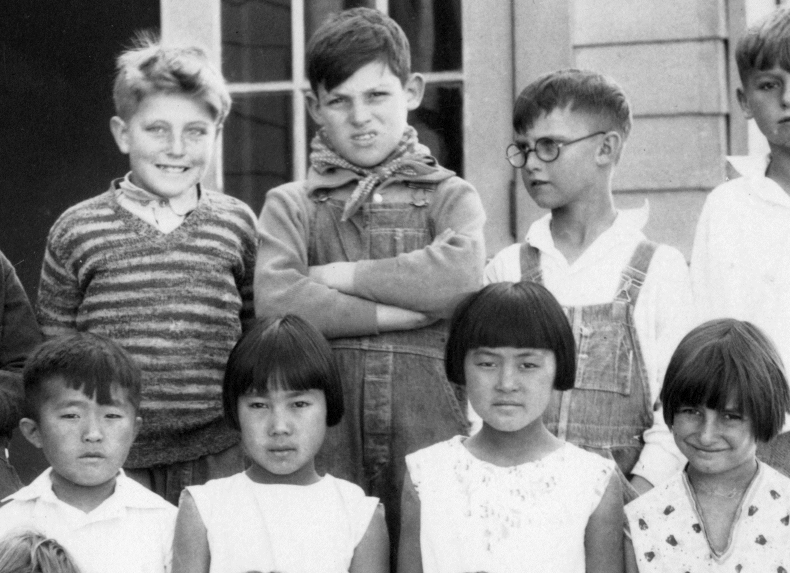
GAMUT OF EMOTIONS - A snip of the full image in the exhibit reveals the range of emotions on school picture day at Ocean View Grammar School.
(Photo courtesy of the Furuta family) © All rights reserved.
GRAMMAR SCHOOL DAYS: Farm children in the Smeltzer and Wintersburg Village areas (now both part of north Huntington Beach) attended the Ocean View Grammar School which was located at the southwest corner of Beach Boulevard and Warner Avenue (where the Comerica building stands today). Among the students in the photograph are children from the Furuta and Akiyama families, two of Wintersburg Village’s three goldfish farmers. You can almost feel the anxious excitement of the children in this photograph, ready for the end of the school day when they can run back through the rural countryside to home.
Learn about Huntington Beach's unique pioneer history!
Stop by the Main Street Library to see the full, original images from our pioneer settlement days! Learn more about Historic Wintersburg at our sister blog, http://historicwintersburg.blogspot.com/
© All rights reserved. No part of the Historic Huntington Beach blog may be reproduced or duplicated without prior written permission from the author and publisher, M. Adams Urashima.
It's only fitting that the Main Street Library---listed along with Triangle Park on the National Register for Historic Places in fall 2013---host historical photography exhibits that share the story of Huntington Beach.
The third in a series of exhibits---organized by the Huntington Beach Historic Resources Board---was just installed, featuring images from the Wintersburg Village (AKA Historic Wintersburg). The Wintersburg Village---which began forming in the late 1800s---was a distinct population center from the Huntington Beach Township on early U.S. Census records. It was annexed into Huntington Beach in 1957, but was connected with Huntington Beach commerce, civic events and daily life from the beginning.
ON THE NATIONAL REGISTER - The Huntington Beach historical photography exhibit is at the Main Street Library, 525 Main Street, on Triangle Park. Both the mid-Century modern Library and Triangle Park were placed on the National Register of Historic Places in fall, 2013, after an effort by local residents. Look for the grandfather clock inside, crafted by the Huntington Beach High School class of 1915.
The photography exhibit images reveal shared history with the pioneer settlement era of Huntington Beach.
Historic Wintersburg was named in June 2014 as one of America's 11 Most Endangered Historic Places by the National Trust for Historic Preservation. There is a current effort to save the six historic structures and 4 1/2-acre property from demolition, which could occur as early as May 2015. It is the only historical place of its type in California.
INSPIRED - The images of Historic Wintersburg have caught the imagination of many across the country. This painting is the work of Phoenix artist, Julie Cox, inspired after reading the the blog and book, Historic Wintersburg in Huntington Beach. (Image courtesy of Julie Cox, Phoenix, Arizona, 2014) © All rights reserved.
Here's what you'll view:
A BUNGALOW IN WINTERSBURG: Yukiko Furuta, standing on the steps of her new home in Wintersburg Village in 1913, facing what was then the muddy country road that was Wintersburg Avenue (now, a paved, multi-lane Warner Avenue). This bungalow---with its original red iron oxide paint and sharp, white trim---is one of six historic structures still standing at Historic Wintersburg.
FOUNDING FATHER - At left, a snip of the full image in the exhibit, taken on the steps of the Huntington Inn, May 1912. The exhibit photograph shows Huntington Beach's first mayor, Ed Manning, among a crowd that included four of Huntington Beach's first mayors, along with goldfish farmer Charles Furuta and a founder of the Wintersburg Mission, Reverend Hisakichi Terasawa. (Photo courtesy of the Furuta family) © All rights reserved.
CROWDFUNDING FOR THE PIER, VERSION 1912: On the steps of the Huntington Inn in 1912, leaders from Wintersburg Village’s Japanese American community and the Huntington Beach township leadership, standing together. In the photograph are four of Huntington Beach's first mayors: Ed Manning, Matthew Helme, Thomas Talbert and Eugene French (front and center). Historic Wintersburg's Charles Furuta is standing at the front left row below the first step. It is believed this meeting was about fundraising to rebuild the Huntington Beach pier, which had just been blown down by a Pacific storm. When the pier was rededicated in 1914, the Japanese community was prominently featured in the celebrations right after a surfing demonstration by George Freeth. Placed high on the agenda (indicating significant support), they performed a sword dance just before the concert band finale and illumination of the pier. Thousands attended the ceremonies.
AFTER 26 YEARS - At right, a snip of the full image in the exhibit, the congregation and clergy from Wintersburg and nearby Westminster gather to celebrate their official designation as a Church in 1930. (Photo courtesy of Wintersburg Presbyterian Church) © All rights reserved.
A DREAM REALIZED: An image of the community and congregation that supported the Wintersburg Mission effort, founded in 1904 after clergy began reaching out in 1902 to workers arriving in the celery fields. The Mission group first met in a barn in Wintersburg Village. The first Mission building was constructed by 1910. In 1930, the date of the exhibit photograph, the Mission had been officially recognized as a Church by the Presbyterian Church USA. Look in the distance, and you'll see the bungalow of Charles and Yukiko Furuta.
SUGAR BEET DAYS: Did you know Huntington Beach, Wintersburg and Smeltzer once produced thousands of tons of sugar beets? Huntington Beach township was the site of one of the Holly Sugar Company factories, processing the giant roots into the sweet stuff we love. The exhibit includes an image of Charles Furuta dumping a wagonload of sugar beets from an elevated platform into a Southern Pacific rail car at a railroad siding in the Wintersburg Village area, circa 1914-1915. The Southern Pacific tracks can still be seen today, parallel to Gothard Avenue.
PIONEER AVIATION - A snip of the full image for the Smeltzer Flying Company, a photograph taken by Charles Furuta on the day aviator Koha Takeishi flew into Wintersburg, March, 1913. The farmers in Wintersburg and Smeltzer raised $4,000 to buy Takeishi his plane. The entire Wintersburg community came out to see the plane, dressed in their Sunday best. (Photo courtesy of the Furuta family) © All rights reserved.
SMELTZER FLYING COMPANY: At the time of the Wright Brothers, Japanese aviator Koha Takeishi was a young man visting from Japan, attending college in Utah. Takeishi worked the celery fields in Wintersburg during his summer breaks and managed to take flying classes at the Curtiss Flying School in north San Diego County. Japanese farmers in Wintersburg were so impressed, they formed the Smeltzer Flying Company and raised $4,000 to help him buy his own plane. This photo, taken by Charles Furuta in March 1913, is from Takeishi's flight from Dominguez airfield in Los Angeles a field in Wintersburg. Read more about the Smeltzer Flying Company on our sister blog, Historic Wintersburg in Huntington Beach, http://historicwintersburg.blogspot.com/2012/04/smeltzer-flying-company-members-of.html
GAMUT OF EMOTIONS - A snip of the full image in the exhibit reveals the range of emotions on school picture day at Ocean View Grammar School.
(Photo courtesy of the Furuta family) © All rights reserved.
GRAMMAR SCHOOL DAYS: Farm children in the Smeltzer and Wintersburg Village areas (now both part of north Huntington Beach) attended the Ocean View Grammar School which was located at the southwest corner of Beach Boulevard and Warner Avenue (where the Comerica building stands today). Among the students in the photograph are children from the Furuta and Akiyama families, two of Wintersburg Village’s three goldfish farmers. You can almost feel the anxious excitement of the children in this photograph, ready for the end of the school day when they can run back through the rural countryside to home.
Learn about Huntington Beach's unique pioneer history!
Stop by the Main Street Library to see the full, original images from our pioneer settlement days! Learn more about Historic Wintersburg at our sister blog, http://historicwintersburg.blogspot.com/
© All rights reserved. No part of the Historic Huntington Beach blog may be reproduced or duplicated without prior written permission from the author and publisher, M. Adams Urashima.
Subscribe to:
Comments (Atom)