Showing posts with label Main Street Library. Show all posts

Saturday, October 11, 2014

New historical photography displayed at Huntington Beach's Main Street Library

ABOVE: Enter the main reading room at the Main Street Library and look up! An exhibit of historical images from Historic Wintersburg in Huntington Beach grace the walls.  Informational materials are at the front counter. (Photo, October 2014)

   It's only fitting that the Main Street Library---listed along with Triangle Park on the National Register for Historic Places in fall 2013---host historical photography exhibits that share the story of Huntington Beach.

  The third in a series of exhibits---organized by the Huntington Beach Historic Resources Board---was just installed, featuring images from the Wintersburg Village (AKA Historic Wintersburg).  The Wintersburg Village---which began forming in the late 1800s---was a distinct population center from the Huntington Beach Township on early U.S. Census records.  It was annexed into Huntington Beach in 1957, but was connected with Huntington Beach commerce, civic events and daily life from the beginning.  

ON THE NATIONAL REGISTER - The Huntington Beach historical photography exhibit is at the Main Street Library, 525 Main Street, on Triangle Park. Both the mid-Century modern Library and Triangle Park were placed on the National Register of Historic Places in fall, 2013, after an effort by local residents. Look for the grandfather clock inside, crafted by the Huntington Beach High School class of 1915.

   The photography exhibit images reveal shared history with the pioneer settlement era of Huntington Beach.

   Historic Wintersburg was named in June 2014 as one of America's 11 Most Endangered Historic Places by the National Trust for Historic Preservation.  There is a current effort to save the six historic structures and 4 1/2-acre property from demolition, which could occur as early as May 2015.  It is the only historical place of its type in California.

INSPIRED - The images of Historic Wintersburg have caught the imagination of many across the country.  This painting is the work of Phoenix artist, Julie Cox, inspired after reading the the blog and book, Historic Wintersburg in Huntington Beach. (Image courtesy of Julie Cox, Phoenix, Arizona, 2014) © All rights reserved.

Here's what you'll view:

A BUNGALOW IN WINTERSBURG: Yukiko Furuta, standing on the steps of her new home in Wintersburg Village in 1913, facing what was then the muddy country road that was Wintersburg Avenue (now, a paved, multi-lane Warner Avenue). This bungalow---with its original red iron oxide paint and sharp, white trim---is one of six historic structures still standing at Historic Wintersburg

FOUNDING FATHER - At left, a snip of the full image in the exhibit, taken on the steps of the Huntington Inn, May 1912.  The exhibit photograph shows Huntington Beach's first mayor, Ed Manning, among a crowd that included four of Huntington Beach's first mayors, along with goldfish farmer Charles Furuta and a founder of the Wintersburg Mission, Reverend Hisakichi Terasawa. (Photo courtesy of the Furuta family) © All rights reserved.
 
CROWDFUNDING FOR THE PIER, VERSION 1912: On the steps of the Huntington Inn in 1912, leaders from Wintersburg Village’s Japanese American community and the Huntington Beach township leadership, standing together. In the photograph are four of Huntington Beach's first mayors: Ed Manning, Matthew Helme, Thomas Talbert and Eugene French (front and center). Historic Wintersburg's Charles Furuta is standing at the front left row below the first step.  It is believed this meeting was about fundraising to rebuild the Huntington Beach pier, which had just been blown down by a Pacific storm.  When the pier was rededicated in 1914, the Japanese community was prominently featured in the celebrations right after a surfing demonstration by George Freeth.  Placed high on the agenda (indicating significant support), they performed a sword dance just before the concert band finale and illumination of the pier.  Thousands attended the ceremonies.

AFTER 26 YEARS - At right, a snip of the full image in the exhibit, the congregation and clergy from Wintersburg and nearby Westminster gather to celebrate their official designation as a Church in 1930. (Photo courtesy of Wintersburg Presbyterian Church) © All rights reserved.

A DREAM REALIZED: An image of the community and congregation that supported the Wintersburg Mission effort, founded in 1904 after clergy began reaching out in 1902 to workers arriving in the celery fields.  The Mission group first met in a barn in Wintersburg Village. The first Mission building was constructed by 1910.  In 1930, the date of the exhibit photograph, the Mission had been officially recognized as a Church by the Presbyterian Church USA.  Look in the distance, and you'll see the bungalow of Charles and Yukiko Furuta.

DON'T LOOK DOWN - A snip of a full image similar to that in the exhibit, Charles Furuta of Historic Wintersburg, driving his horse and wagon up the Southern Pacific Railroad siding at Wintersburg, circa 1914-1915. The full image at the Main Street Library shows Furuta dumping the wagonload of sugar beets into a railroad car. (Photo courtesy of the Furuta family). © All rights reserved.

SUGAR BEET DAYS: Did you know Huntington Beach, Wintersburg and Smeltzer once produced thousands of tons of sugar beets?  Huntington Beach township was the site of one of the Holly Sugar Company factories, processing the giant roots into the sweet stuff we love.  The exhibit includes an image of Charles Furuta dumping a wagonload of sugar beets from an elevated platform into a Southern Pacific rail car at a railroad siding in the Wintersburg Village area, circa 1914-1915.  The Southern Pacific tracks can still be seen today, parallel to Gothard Avenue.

PIONEER AVIATION - A snip of the full image for the Smeltzer Flying Company, a photograph taken by Charles Furuta on the day aviator Koha Takeishi flew into Wintersburg, March, 1913.  The farmers in Wintersburg and Smeltzer raised $4,000 to buy Takeishi his plane.  The entire Wintersburg community came out to see the plane, dressed in their Sunday best. (Photo courtesy of the Furuta family) © All rights reserved.

SMELTZER FLYING COMPANY: At the time of the Wright Brothers, Japanese aviator Koha Takeishi was a young man visting from Japan, attending college in Utah.  Takeishi worked the celery fields in Wintersburg during his summer breaks and managed to take flying classes at the Curtiss Flying School in north San Diego County.  Japanese farmers in Wintersburg were so impressed, they formed the Smeltzer Flying Company and raised $4,000 to help him buy his own plane.  This photo, taken by Charles Furuta in March 1913, is from Takeishi's flight from Dominguez airfield in Los Angeles a field in Wintersburg.  Read more about the Smeltzer Flying Company on our sister blog, Historic Wintersburg in Huntington Beach, http://historicwintersburg.blogspot.com/2012/04/smeltzer-flying-company-members-of.html
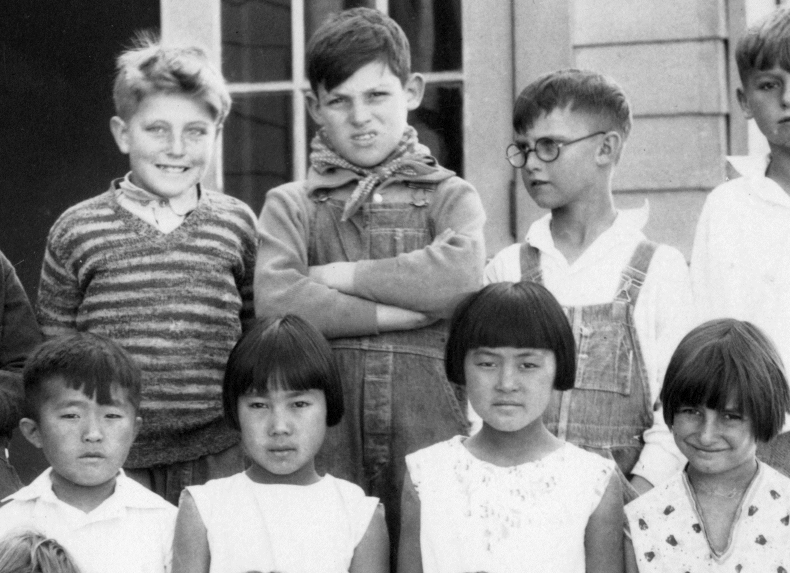
GAMUT OF EMOTIONS - A snip of the full image in the exhibit reveals the range of emotions on school picture day at Ocean View Grammar School.
(Photo courtesy of the Furuta family) © All rights reserved.


GRAMMAR SCHOOL DAYS: Farm children in the Smeltzer and Wintersburg Village areas (now both part of north Huntington Beach) attended the Ocean View Grammar School which was located at the southwest corner of Beach Boulevard and Warner Avenue (where the Comerica building stands today). Among the students in the photograph are children from the Furuta and Akiyama families, two of Wintersburg Village’s three goldfish farmers.  You can almost feel the anxious excitement of the children in this photograph, ready for the end of the school day when they can run back through the rural countryside to home.

Learn about Huntington Beach's unique pioneer history!
   Stop by the Main Street Library to see the full, original images from our pioneer settlement days!  Learn more about Historic Wintersburg at our sister blog, http://historicwintersburg.blogspot.com/

© All rights reserved.  No part of the Historic Huntington Beach blog may be reproduced or duplicated without prior written permission from the author and publisher, M. Adams Urashima.

Tuesday, April 30, 2013

It's historic! Main Street Library and Triangle Park listed on National Register

   We're 104-years-old and getting older everyday.  And now, one of our treasured local landmarks has been recognized for its contributions and place in the history of Huntington Beach.

   On April 16, 2013, the U.S. Department of the Interior National Park Service announced the Huntington Beach Public Library on Triangle Park is listed on the National Register of Historic Places.

   Within days of the City's incorporation "some local organizations and the Huntington Beach Women's Club called a mass meeting on February 15, 1909, to form a library association."  There weren't many paved streets, we were still trying to install lighting and telephone service, but at the top of the agenda for the community was the establishment of a public library. And so it began in a borrowed wooden building, with a rocking chair, a few lamps and the community's first collection of books.

   The Huntington Beach Public Library on Triangle Park became the City's sole library in 1951, sitting atop one of our oldest parks--once the site of early 1900s baseball games, horseshoe tournaments and checkerboard chats.   It is spot #12 and #13 on the historic downtown Walking Tour.

   Since the opening of our Main Street Library, our nation has witnessed the Civil Rights Movement, the Korean War, the release of the Beatles and Billy Holiday's first LPs, man walking on the moon, the Vietnam War, the fall of the Berlin Wall, eleven presidents, the birth of Rock and Roll, the birth of Rap, the invention of the Internet, Facebook, Youtube, texting, WiFi, and Twitter.  Our little library was there for the introduction of Marshmallow Peeps, Tang, old Coketurducken, Watergate salad, New Coke, California rolls, Classic Coke, TofurkeySmart Water, kale everything, deep fried Twinkies, the demise of the Twinkie, and Kogi BBQ.

   Through all the cultural and social changes, it's always been about the books, the open sharing of information, "...the one secular institution which encourages self development as an aim." (Josiah P. Quincy, 1875)

   Congratulations little library!  Well done.
 

Read more about the history of the Main Street Library and Triangle Park, Historic Walking Tour #12 and #13: Main Street Library and Triangle Parkhttp://www.historichuntingtonbeach.blogspot.com/2012/08/historic-walking-tour-12-and-13-main.html and Saving History: The Main Street Library and Triangle Park, http://historichuntingtonbeach.blogspot.com/2012/12/saving-history-main-street-library-and.html

Saturday, April 6, 2013

Hidden History: Huntington Beach's "Old Civic Center" and Memorial Hall

ABOVE: American eagles, the California State Seal and an early Huntington Beach seal, were saved from demolition at the City's Old Civic Center.   (Photo, M. Urashima, April 2013) © All rights reserved.


   Hidden away in the public works yard parking lot are survivors of Huntington Beach's Old Civic Center, once located between 5th and 6th streets in the historic downtown.  Previously the site of one of the first grammar schools, the original Civic Center was situated next to present-day Triangle Park, home of the Main Street Library. 

ABOVE: After washing away the dust, a small metal plaque reveals the history of the monument to early Huntington Beach, re-dedicated in the public works yard over thirty years ago. Note the date of 1930, should be 1923, the year the city hall at the Old Civic Center opened. (Photo, M. Urashima, April 2013) © All rights reserved.
 
ABOVE: The eagles originally were not painted and matched the stonework on the building.  Today, the pair of eagles have landed near the public works administration offices. (Photo, M. Urashima, April 2013) © All rights reserved.  

ABOVE: Close up of painting detail on eagle. (Photo, M. Urashima, April 2013) © All rights reserved.

   In a Civic Center history published by the City in 1974, the firm of Walker and Eisen is reported as the architects of the city hall and auditorium.
 
   Based in Los Angeles, Walker and Eisen also designed the twelve-story Fine Arts Building on 7th Street in Los Angeles, which was designated as a Historic Cultural Monument in 1974 and is featured in the film, 500 (Days of Summer).  Walker and Eisen's other buildings include the Hotel Normandie and the Beverly Wilshire Hotel.
 
ABOVE: Under construction - From a different angle, the solid brick "new city hall" under construction circa 1922.  The original Pacfic City city hall--predating the 1909 incorporation of Huntington Beach--operated out of a building at 122 Main Street.  (Photo, City of Huntington Beach Archives, circa 1922)

   The Old Civic Center opened its doors in 1923 and served as Huntington Beach's official seat of government for 51 years.  The impressive stairway led to the second floor where main city government offices were located.

   The Civic Center history notes, "Many notable decisions were made by the board of trustees (city council) during this time, one of which awarded the contract for the installation of the ornamental street lights along Main Street from Mansion (Yorktown) Avenue to the ocean."

ABOVE: A City of Huntington Beach seal from the Old Civic Center features ocean waves and Catalina Island across the sea.  Also noted is the City's birthday, February 17, 1909, (we're Aquarius, a water sign, naturally).  (Photo, M. Urashima, April 2013) © All rights reserved.

ABOVE: The State Seal,  simplified version not featuring the official seal's golden bear and ships in the harbor, but including the Greek phrase, "Eureka," meaning "I have found it."  The wheat sheaf symbolism typically means prosperity, the harvest of one's hopes, and is a nod to Huntington Beach's agricultural roots.  The axe symbolizes patriotism and military duty.  (Photo, M. Urashima, April 2013) © All rights reserved.

   The 1933 earthquake damaged the city hall building, causing city staff to move into tents around the civic center for a short period.  The municipal tent city was a reminder of the temporary shelters in Huntington Beach's earliest years when housing construction could not keep pace.  This included the Bungalette Court, known by locals as "Cardboard Alley," allowed for a short time on a portion of Block 505 (Triangle Park) until directed to vacate by the city council in July, 1923.

ABOVE: This 1930s photograph of the art deco Memorial Hall at the Civic Center locates the stone eagles on pedestals flanking the main entrance.  The Memorial Hall was dedicated in 1931.  (Photo, City of Huntington Beach archives)

ABOVE: The finished city hall building, reveals the City and State seal plaques above arched niches at the entrance.  (Photo, City of Huntington Beach archives)

    When fully established, the Old Civic Center included the city hall, Memorial Hall (of which the second floor was managed by the American Legion), fire and police departments, chamber of commerce, and the Horseshoe Clubhouse with recreational activities and a ballpark on present-day Triangle Park.
  
   The Horseshoe Clubhouse was constructed at the civic center in 1931 and put into use by community groups.  See photos of the Horseshoe Club at http://www.historichuntingtonbeach.blogspot.com/2012/08/historic-walking-tour-12-and-13-main.html  

   During World War II, the Clubhouse was occupied by the Red Cross until they were asked to vacate after the war in 1950.  In the late 1960s, key city departments relocated to the Clubhouse when they outgrew city hall.
 

ABOVE: Inside the Memorial Hall auditorium, circa 1940, which was managed by the American Legion. The little boy at front, center, does not appear happy to be in the adult crowd. The couple in the lower right seem to be having a better time.  (Photo, City of Huntington Beach archives)

ABOVE: A war memorial was installed in 1949 on the 5th Street side of the civic center.   During World War II, a watchtower was stationed on the roof of Memorial Hall.  (Photo, City of Huntington Beach archives)

  By the early 1970s,  the City departments were spread out into multiple buildings and planning began for the new Civic Center at Main Street and Yorktown Avenue where it remains today.  A decision was made to demolish the old civic center and redevelop the land as housing.

ABOVE: Demolition of the Old Civic Center, circa 1974, with apparent brick salvage.  (Photo, City of Huntington Beach archives)

ABOVE: Memorial Hall demolition, circa 1974, the eagles saved by some unknown hero.  Its unknown if someone saved the wings above the entrance.  (Photo, City of Huntington Beach archives)

   From 1945 to 1972, the City of Huntington Beach grew from its original 3.57 square miles to almost 28 square miles.  The City's population boomed from 11,000 in 1960 to 150,000 in 1974.  In a little over a decade, Huntington Beach had become the fastest growing city in the United States.

ABOVE: Civic Center construction at present-day Main Street and Yorktown, across from Huntington Beach High School, circa 1974.  (Photo, City of Huntington Beach archives)

   By 1968, the City purchased the new civic center site at Main Street and Mansion (Yorktown) Avenue, across from Huntington Beach High School.  The new city hall--designed by architect Kurt Meyer, who designed a number bank buildings in Los Angeles--opened its doors in 1974.  

   The dedication event featured bands from Huntington Beach and Marina high schools, the Edison High School drill team, and hostesses from the Orange Coast College stewardess trainees.  The dedication address was made by Robert H. Finch, Counselor to President Richard Nixon, with a presentation of keys to the building by the architect.

   Six years later, the paired eagles and plaques from the Old Civic Center quietly found their new home in the public works yard.

ABOVE: An aerial of the Old Civic Center, circa 1950, shows the building placement.  The city hall and Memorial Hall site is now condominiums.  The Triangle Park site is retained with the 1951 Main Street Library.  (Photo, City of Huntington Beach archives).

Location: The monument to the Old Civic Center is located in the parking lot of the City of Huntington Beach public works corporation yard, 17371 Gothard Street, between Slater and Warner avenues.  It can be viewed during the days and hours the public works offices are open.

All rights reserved.  No part of the Historic Huntington Beach blog may be reproduced or duplicated without prior written permission from the author and publisher, M. Adams Urashima.   

Thursday, January 31, 2013

Overhead: A bird's-eye view of Historic Huntington Beach, 1938 - 1968

A "panorama" of Huntington Beach in 1938.  Arches over the intersection of Main Street and Ocean Avenue are visible, as is the saltwater plunge next to the pier.  Note the oil wells in the background. (Photo, City of Huntington Beach archives)


A parade down Main Street, circa 1940s.  (Photo, City of Huntington Beach archives)


A view of the old Civic Center in the downtown, circa 1940s.  (Photo, City of Huntington Beach archives)


Huntington Beach State Beach, circa 1940s.  (Photo, City of Huntington Beach archives)


Old Civic Center area off Main Street, prior to construction of the Main Street Library on Triangle Park, circa 1950.  (Photo, City of Huntington Beach archives)

A view looking west to the developing Huntington Beach and the Pacific Ocean beaches in 1957.  (Photo, City of Huntington Beach archives)

North side of Main Street, the clock tower of Huntington Beach High School can be seen in the upper right, circa 1960.  (Photo, City of Huntington Beach archives)


Downtown Huntington Beach and the pier, circa 1968.  (Photo, City of Huntington Beach archives)

All rights reserved.  No part of the Historic Huntington Beach blog may be reproduced or duplicated without prior written permission from the author and publisher, M. Adams Urashima.   

Tuesday, January 15, 2013

The Walking Tour: Review of our 2012 featured spots in the historic downtown


   In the past year, Historic Huntington Beach has featured a few of the stops on the downtown walking tour, along with other tidbits of local history to make your stroll around town.  We haven't always gone in chronological order, because we tend to wander off (we recommend you wander off the beaten trail, also).  We'll get to spots we missed in 2013!  Here's where we've stopped along the way in 2012.

Visitors Information Kiosk
Stop here first (at the foot of our pier along Pacific Coast Highway) to pick up the printed walking tour brochure.  The brochure offers a map and just enough historical information to make you want to learn more!

The Huntington Beach pier and bandstand, circa 1914.  It didn't take long to figure out everyone likes a long walk on a longer pier. (Photo, Library of Congress)

The Huntington Beach Pier
 The pier has been a fixture on our coast for well over one hundred years.  Each time the Pacific knocked it down, we rebuilt.  Take a look at a century of pier-story at http://www.historichuntingtonbeach.blogspot.com/2012/05/huntington-beach-near-pier-and.html

   We've also included some history about the early attempts at pier wave motors and the "Man Angel," the oddest flying machine you've ever seen, "Masters of the Ocean Waves," http://historichuntingtonbeach.blogspot.com/2012/05/masters-of-ocean-waves.html

The Pavalon (this photo circa 1946) is no longer.  It was the place to take your date, jump into the saltwater plunge, and dance like nobody's business.

The Pavalon Ballroom
    We included one of the old photographs and a little information about the famous Pavalon in Smoked Fish and the Surfer Stomp, http://www.historichuntingtonbeach.blogspot.com/2012/05/smoked-fish-and-surfer-stomp.html  More to come in 2013


Helme-Worthy House and M.E. Helme House Furnishing Co.
   A treasure for many reasons, this National Historic Register site is the legacy of one of Huntington Beach's first families and remains in their ownership.  The 1904 M.E. Helme House Furnishing Co. is adjacent to the 1880s Helme-Worthy House which was moved to the property by mule team in 1903.  Browse the antiques, soak up the history and watch the progress of a historic site undergoing painstakingly careful restoration.  Read more at http://www.historichuntingtonbeach.blogspot.com/2012/08/historic-walking-tour-6-me-helme-house.html

The horseshoe courts on Triangle Park, circa 1935.  (Photo by Burton Frasher, Frasher Foto Postcard Collection, Pomona Public Library)

Main Street Library and Triangle Park
   Little Triangle Park once played a role in the early 1900s development of Huntington Beach, providing tent housing for newcomers.  "Cardboard Alley" later became part of the new City's civic center, home to a Horseshoe Club, a Red Cross outpost during World War II, and home to many community groups before it became the City's main library in the 1950s.  Read more at http://www.historichuntingtonbeach.blogspot.com/2012/08/historic-walking-tour-12-and-13-main.html and http://www.historichuntingtonbeach.blogspot.com/2012/12/saving-history-main-street-library-and.html

Oil Field Beach Cottage
   A significant part of the quality of life of residential districts in Huntington Beach's historic downtown is the collection of eclectic beach cottages and bungalows on Main Street and the surrounding streets.  Many of them have a story to tell. Read more and view some of our other classic bungalows and cottages at http://www.historichuntingtonbeach.blogspot.com/2012/08/historic-walking-tour-14-beach-cottages.html

The Beach Court
   The Beach Court was built in 1923 during the early days of the motion picture era, the same year the famous Hollywoodland (now Hollywood) sign was installed in the hills above Los Angeles.  It was an escape for a few celebrities from Los Angeles, including silent film star Rudolph ValentinoRead more at http://historichuntingtonbeach.blogspot.com/2012/09/walking-tour-16-beach-court-and.html 

The Shank House   This 1913 class Craftsman-style bungalow was the home to Dr. George A. Shank, of one of Huntington Beach's first doctors, first City health officer, and member of the City Board of Trustees (predecessor to the city council).  A few steps away is the original city hall and jail that Dr. Shank helped finance.  Today, Dr. Shank's home is a police substation in the historic downtown.  Read more at http://historichuntingtonbeach.blogspot.com/2012/05/historic-walking-tour-19-shank-house.html 

1908 City Hall and Jail
   The original city hall and jail on 5th Street--built in 1908, one year before Huntington Beach incorporated--is now home to HB Top Nails What sent you to jail in early 1900s Huntington Beach?  In addition to the usual (horse thievery, murder, allowing your chickens to run wild), it was alcohol (unless you were a licensed pharmacist) and gambling that landed you in the little big house. Read more at http://www.historichuntingtonbeach.blogspot.com/2012/04/historic-walking-tour-huntington-beachs.html


Main Street Post Office
   Seventy-five years after the Pony Express and twenty-eight years before the introduction of the zip code, Huntington Beach opened the doors to the Main Street Post Office in 1935.  It was a big deal.  Specifically, an aspect of the New Deal.  Our Depression-era post office still delivers in the historic downtown. Read more at http://www.historichuntingtonbeach.blogspot.com/2012/10/walking-tour-22-wpa-main-street-post.html


The Golden Bear
    Ask a Huntington Beach local about the Golden Bear and watch them get all misty eyed.  They'll tell you stories about the musicians and comedians, about grabbing a beer and having the night of their life, and then stepping outside to ocean air and crashing waves.  It was a soulful little place that put us on the map.  Read more at http://historichuntingtonbeach.blogspot.com/2012/05/historic-walking-tour-27-golden-bear.html

Off the beaten path...
  Among the stops we've included in 2012 are a few off the beaten path, but rich with local history.   Here's a few of the favorites:

Brewster's Ice: Since 1945
Update: Brewster's Ice is currently being remodeled, although some historic features remain. As of January 2018, we await the "new" ice house.

   Before refrigerators were in every home, there was the "ice man."  At the corner of Lake and 6th Streets, Brewster's Ice has been a family-run business for 67 years. They still sell block ice, dry ice, special orders for events, and they deliver in Huntington Beach...just like the "olden days."  Read more at http://historichuntingtonbeach.blogspot.com/2012/09/brewsters-ice-since-1945.html


The Gordie House
   UPDATE: Gordie Higgins surf shack was remodeled and no longer looks like this, although the structure is still there.

Who is Gordie and why does the tiny building behind 505 Lake Street bear his name?  If you're a surfer, you might already know.  Gordie Higgins was one of Huntington Beach's first surfboard shapers at a time when boards were actually, well, boards.  Read more at http://historichuntingtonbeach.blogspot.com/2012/11/the-gordie-house.html


Fire Pits and Beach Camping 
   Visitors to Huntington Beach always comment on the pit fires dotting the beach at night.  It's routine for locals to celebrate birthdays, reunions or ordinary get-togethers with a circle of friends at a beach fire.  It's also a long tradition, dating back a hundred years to when beach living was a necessity.  Read more at http://historichuntingtonbeach.blogspot.com/2012/05/sea-breeze-auto-camp-circa-1935.html 

   We're now 104-years-old and, well, we're a bit of a character.  Stick with us in 2013....we've got a few more stories to tell as we walk though Historic Huntington Beach.

All rights reserved.  No part of the Historic Huntington Beach blog may be reproduced or duplicated without prior written permission from the author and publisher, M. Adams Urashima.