Showing posts with label National Register of Historic Places. Show all posts

Saturday, September 23, 2017

Newland House: Saving our pioneer history

ABOVE: The Newland House Museum after a rain. Once endangered and in disrepair, it was a decades-long community effort to save and restore the 1898 structure as part of the development agreement with the Newland Shopping Center.  As of 2017, the recent refurbishment of the Newland Shopping Center reflects design elements complementing the National Register of Historic Places-listed house museum. (Photograph, M. Urashima. October 24, 2016) © ALL RIGHTS RESERVED     

   History takes a long time to make. And, a long time to save.  In the case of this local and national historical landmark, it took decades of community volunteer effort--and near loss to neglect, vandalism and disrepair--to save a historic site now considered a treasure.
1964
   It was 1964 when local residents began voicing a concern about the Newland House, calling for it to be saved and restored to its former glory as the headquarters of the 1,000-acre Newland Rancho.  In the fast-paced, mid 20th-Century building boom, the community discussion is reminiscent of most historic preservation efforts: What is historic?  Why did the original owners sell it?  Should the Newland House be demolished to allow for the construction of a new shopping center?  Why should historic preservation be part of community planning?

   The Newland family--no longer farming or ranching--had already sold their property and, in 1964, it was owned by Signal Oil & Gas Company.  The Huntington Beach Chamber of Commerce manager, William Gallienne, advocated moving the house to get it out of the way of progress.   

RIGHT: Mayor Don Shipley with Miss Huntington Beach Rosemary Southward, in front of the Newland House in 1964. Shipley advocated for its historic preservation.  (Los Angeles Times, August 3, 1964)

   Mayor Don Shipley--for whom the Shipley Nature Center is named--advocated working with the property owner and developer to save the Newland House and make it a centerpiece of a public park site.  Shipley acknowledged the challenges of restoration, preservation and ongoing stewardship, but advocated his vision for historic preservation.  

LEFT: The Newland House with its outbuildings and the original Newland barn in 1948.  The outbuildings included a bunk house for ranch labor and a sizable barn that almost dwarfed the house.  The barn on the property today is not original and was constructed to provide event space. (City of Huntington Beach archives, 1948)

   Shipley told the Los Angeles Times in 1964 that the Newland House "would make an excellent historical tie for the City".  Shipley's unflagging advocacy of the elements that are important to retain in community planning--history, open space, natural landscapes--led to him being honored in perpetuity at the Shipley Nature Center in 1974.  

   The Shipley Nature Center--off Goldenwest Street--explains on their website, "Dr. Shipley’s vision was to have a place which reflected what California was 100 years ago...so that children would be able to see what Huntington Beach may have been like before intense development began..."  The Shipley Nature Center is today a center for community and school educational programming, and a respite in an increasingly urban environment that has removed most of Huntington Beach's early history.

LEFT: Delbert "Bud" Higgins in front of the Newland House. Behind him, the exterior paint is peeling and windows are either open or boarded up. Higgins advocated for saving the community's pioneer history and the pre-history of California's indigenous people. (Los Angeles Times, April 27, 1976)

1974-1980
   Twelve years after the first article, the Los Angeles Times published another article about the grassroots historic preservation effort to save the Newland House.  It featured a photograph of Delbert "Bud" Higgins, a long-time local and community historian, standing in front of the Newland House again.  The Newland House looked more neglected, but those involved in the preservation effort refused to give up.  By then, community residents had formed the Huntington Beach Historical Society and began holding fundraising events to generate funds and friends.

   Higgins--who, with his brother, Gordie, began making the first redwood surfboards in Huntington Beach after watching Duke Kahanmoku and "the Hawaiians" surf Corona del Mar in the 1920s--had seen radical changes to the Huntington Beach historical and cultural landscape in his lifetime.  He talked about the pre-history of the indigenous people of California and the 19th-Century pioneer settlement history represented by the Newland House.

   "Indians lived on this mesa more than a thousand years ago," Higgins, who was Huntington Beach's first lifeguard and first fire chief, told the Los Angeles Times, after picking up a clam shell in the yard of the Newland House while taking the reporter on a tour. "They'd go down into the tidal basin mud flats below, gather clams and cook them."

RIGHT: An example of the Native Californian basketry that was part of the Newland family collection of Mary Juanita DeLapp Newland.  The majority of the collection is held by the Bowers Museum in Santa Ana.  The Works Progress Administration helped with an archaeological investigation of the Newland House property in the 1930s, resulting in "two wagon loads" of artifacts removed from the mesa and "housed in Santa Ana", according to local historian Bud Higgins.  Some artifacts were reported by the Times as dating to 5,000 B.C. In 1980, another archaeological investigation documented a native American burial on the property. (Image, Los Angeles Times, June 29, 1980) 

  A major breakthrough came to the historic preservation effort in April 1974, when Signal Landmark Homes donated the Newland House and land to the community for a historical public park, as mitigation for their housing development.  The original plans were to encircle the house with a retail center.  After community objections, Signal Landmark changed their plans and lowered an office buildng by ten feet to retain the Newland House's view  of the Pacific Ocean and promised that the retail center's architectural features would complement the historic structure.

LEFT: The Newland House in 1970, missing an exterior wall.  The old wooden garage structure--which no longer exists--can be seen in the yard. (Photograph, City of Huntington Beach archives, circa 1970)

   A dozen years after the historic preservation effort was initiated in 1964, the community was rallying behind the effort.  Students at three local junior high schools holding a bike-a-thon as a fundraiser.  Descendants of the Newland family offered support by donating a few artifacts, historical ephemera, and helping locate furnishings to re-create the dining room as they remembered it.  

   Very little of the original furnishings remained, as family members did not realize their home would be considered historic.  Community members scoured antique markets and asked for donations of period-appropriate items to furnish the house museum.

RIGHT: A table set for pioneer holidays inside the Newland House dining room.  The Huntington Beach Historical Society and Huntington Beach's Historic Wintersburg Preservation Task Force will roll the clock back 100 years again at their fourth annual "Holidays in Huntington Beach" at the Newland House on Friday, December 1.  This year, it will be 1917! (Photograph, M. Urashima, November 30, 2014) © ALL RIGHTS RESERVED    

   Like most historic preservation efforts, the call to save the Newland House was initiated by people other than the family whose history it represents.  Historic preservationists took the larger view that the property's significance was important to the community and region, and that the community would undertake saving it.

   The Newland family had ten children, two of whom were born in the house.  The family had sold the property and had not lived in the home for more than 20 years.  The Los Angeles Times interviewed one of the descendants born in the house, Helen Newland Tarbox, in 1976.

LEFT: The Newland House, as it appeared prior to its stabilization and preservation, with barbed wire security fencing and in disrepair. (Photograph, City of Huntington Beach archives, October 15, 1976)

   Helen Newland Tarbox--then 75 years old and living in Newport Beach--remarked, "More power to the Historical Society! What they are doing is great. They've had a hard time of it with no city money. It's going to take time to do the restoration, but they are going to do it."

   Volunteers from Orange Coast College re-roofed the Newland House, while volunteer carpenters and electricians worked to restore the structure.  A crew from the Huntington Beach Fire Department installed a flagpole on the distinctive cupola.  The second floor of the Main Street Branch Library was used to store historical items, while the Newland House was undergoing stabilization and preservation work.  

   Higgins told the Los Angeles Times that the original estimated cost for the historic preservation effort was far less than projected, due to community volunteers and donations.  Once the historic preservation effort was permitted and the project had site control, everybody became a preservationist.  The effort to save local history brought residents together, rolling up their sleeves to help as a point of community pride and civic contribution.

RIGHT: By 1980, over fifteen years after the historic preservation effort began, the Los Angeles Times recounted the Newland House journey through neglect, blight, vandalism (which cannibalized historic fixtures), and the pressures of urbanization.  Members of the community persisted in their work to save the structure for future generations. (Los Angeles Times, June 29, 1980)

   Huntington Beach City Councilman Ted Bartlett told the Los Angeles Times in 1976, at the height of the country's bicentennial, "I'm 100% behind the society's restoration work.  I'm going to donate my money, just like the others."  

   Like Don Shipley, Ted Bartlett's leadership regarding the retention of historical places and open spaces in the city's planning and development prompted a grateful community to honor him in a permanent manner.  The natural wilderness area behind the Newland House--Bartlett Park--is named after Bartlett, who served five four-year terms on the city council.

LEFT: Alice Jumper, a member of the Huntington Beach Historical Society, inside the Newland dining room in 1980.  She is one of the many volunteers who donated countless hours to save the Newland House, now listed on the National Register of Historic Places. She described seeing the house from Beach Boulevard and stopping to take a closer look.  By 1980, Jumper said she was "up to my ears" in her volunteer efforts to help restore the Newland House.  When asked why she cared so much for a place to which she had no familial connection--a question often asked of historic preservationists--she told the Los Angeles Times, "how do you describe love?"  (Los Angeles Times, June 29, 1980) 

1982-1986
   By 1982, the 19.5-acre Newland Shopping Center had opened and was 75-percent leased.   The City of Huntington Beach committed $400,000 for the stabilization and preservation of the Newland House, including associated infrastructure for water and power to the property.  Community members had contributed more in their volunteer labor and donations.

    In 1985, the then 87-year-old  Newland House was listed on the National Register of Historic Places by the National Trust for Historic Preservation.  

LEFT: A new addition to the Newland Shopping Center in 2017, Miguel's Homestyle Mexican Food includes an artful rendering of the National Register-listed Newland House as part of its architectural decor.  The rendering reminds of local residents and visitors of Huntington Beach's agricultural past.  Miguel's is located on ground once occupied by the chile pepper dehydrating warehouses of Masami Sasaki, who was known as the "chile pepper king" and one of the largest chile pepper processors in Southern California prior to World War II. (Photograph, M. Urashima. July 2017)  © ALL RIGHTS RESERVED

    The City of Huntington Beach's financial commitment to the preservation effort led to the construction of a new barn on the Newland House property and the restoration of landscape for a cumulative bid of $272,733.  The barn was built to provide public event space to generate revenue to support the Newland House property.  Today, the "Newland Barn" is a popular site for weddings, birthday parties and other events, and is booked months in advance.  

   Currently, the barn--a single, 1,100-square foot structure with a "patio" area of 22 square feet--generates an average of $53,000 annually, per revenue records provided by the City of Huntington Beach for the years 2000 through 2014.  During those years alone--not including revenue for the mid 1980s through 1990s--the Newland Barn generated close to three-quarters of a million dollars for the City.   The City's Community Services department now holds a lottery to determine who gets reservations on available dates.

RIGHT: A view from Bartlett Park of the Newland House and the "Newland Barn", a new structure constructed in 1983 to provide event space a the Newland House Museum.  The 1,100 square-foot Newland Barn has generated well over a million dollars for the City since its opening. (Photograph, City of Huntington Beach, circa 1986) 

   The City of Huntington Beach's investment in the Newland House property has been repaid many times over.  The ongoing maintenance and continual improvement at the Newland House Museum is born by the Huntington Beach Historical Society, who also provide historical tours, train docents and provide events at the Museum.  The Society improved the property with the back yard gazebo and the reconstruction of the historic water tower, as well as restoration of the garden.  Each year, the Huntington Beach Historical Society awards a "Newland Rose" to community members who make contributions to the preservation of local history.

LEFT: The garden on the south side of the Newland House contains bricks rescued from the demolition of the Holly Sugar Factory, a 1911 sugar processing plant near the original Huntington Beach Township, once located off what is now Garfield Avenue and Holly Lane. Local residents had wanted to save the pioneer-era Holly Sugar Factory for adaptive reuse; it was demolished with little warning on a Saturday. (Photograph, Newland House garden, M. Urashima. November 30, 2014) © ALL RIGHTS RESERVED
1990   
   Eighty-one years after the incorporation of Huntington Beach, the City appointed Michael Mudd as the new cultural affairs director, following a historic resources survey in 1986.  Mudd told the Los Angeles Times that "cultural concerns and historic conservation haven't evolved in Huntington Beach."  He advocated devoting some City investment to organize the various historical organizations and create a long-term plan for preserving local history.  Alas, his position did not last.

1996  
   The Newland House rose garden was dedicated in 1987 and grew over the years through the work of volunteers.  The garden's present-day design was developed with input from the Pacific Coast Archaeological Society in order to avoid archaeological sensitivities on the grounds. 

RIGHT: Newland House trustee Virginia Whipple on the brick walkway of the rose garden in 1996. (Los Angeles Times, November 23, 1996) 

   In 1996, the garden was renovated by the Master Gardeners of Orange County as a volunteer contribution.  The garden has been used for master gardening classes and cooking demonstrations, and is in keeping with the 19th-Century intent of Mary Newland to be both useful as a kitchen garden and a beautiful spot to linger.

LEFT: Darrell Rivers, president of the Huntington Beach Historical Society,  in a photo frame at Holidays in Huntington Beach 1916, an annual joint event with the Historic Wintersburg Preservation Task Force.  The event recreates the community's holiday celebrations of 100 years ago.  It will be 1917 at this year's Holidays in Huntington Beach, on Friday, December 1. (Photograph, Darrell Rivers at the Newland House Museum. M. Urashima. December 2, 2016) © ALL RIGHTS RESERVED

Present day 
   The Huntington Beach Historical Society--in addition to organizing the annual Civil War Days in Central Park, along with other events at the Newland House Museum--continues to provide the stewardship, ongoing maintenance and improvements for the Newland House and garden.  

   The lasting legacy of the Newland family--as well as the efforts of community volunteers who have worked over half a century to save, restore, and maintain this local gem--continue to provide a sense of place and heritage for Huntington Beach, as well as a place for local celebrations.  It is, as Don Shipley predicted in 1964, an "historical tie" that binds our community together.

ABOVE: One of the many cultural events at the Newland House reflecting local heritage, Dia los Muertos, in October 2014.  A group of event-goers, with Huntington Beach Historical Society president Darrell Rivers (far right in top hat) flashed a "W" for Historic Wintersburg, a present day historic preservation effort in Huntington Beach. (Photograph, Dia los Muertos at Newland House Museum. M. Urashima October 2014) © ALL RIGHTS RESERVED

MORE INFORMATION:
The Newland House Museum is located at 19820 Beach Boulevard, in Huntington Beach, California, in the Newland Shopping Center, and is open to the public. Call 714-962-5777 for more information and hours.  The Newland House barn rental information through the City of Huntington Beach can be found at http://www.huntingtonbeachca.gov/residents/parks_facilities/rentals/newland_barn.cfm. 

© All rights reserved. No part of the Historic Huntington Beach blog may be reproduced or duplicated without prior written permission from the author and publisher, M. Adams Urashima.

Saturday, October 11, 2014

New historical photography displayed at Huntington Beach's Main Street Library

ABOVE: Enter the main reading room at the Main Street Library and look up! An exhibit of historical images from Historic Wintersburg in Huntington Beach grace the walls.  Informational materials are at the front counter. (Photo, October 2014)

   It's only fitting that the Main Street Library---listed along with Triangle Park on the National Register for Historic Places in fall 2013---host historical photography exhibits that share the story of Huntington Beach.

  The third in a series of exhibits---organized by the Huntington Beach Historic Resources Board---was just installed, featuring images from the Wintersburg Village (AKA Historic Wintersburg).  The Wintersburg Village---which began forming in the late 1800s---was a distinct population center from the Huntington Beach Township on early U.S. Census records.  It was annexed into Huntington Beach in 1957, but was connected with Huntington Beach commerce, civic events and daily life from the beginning.  

ON THE NATIONAL REGISTER - The Huntington Beach historical photography exhibit is at the Main Street Library, 525 Main Street, on Triangle Park. Both the mid-Century modern Library and Triangle Park were placed on the National Register of Historic Places in fall, 2013, after an effort by local residents. Look for the grandfather clock inside, crafted by the Huntington Beach High School class of 1915.

   The photography exhibit images reveal shared history with the pioneer settlement era of Huntington Beach.

   Historic Wintersburg was named in June 2014 as one of America's 11 Most Endangered Historic Places by the National Trust for Historic Preservation.  There is a current effort to save the six historic structures and 4 1/2-acre property from demolition, which could occur as early as May 2015.  It is the only historical place of its type in California.

INSPIRED - The images of Historic Wintersburg have caught the imagination of many across the country.  This painting is the work of Phoenix artist, Julie Cox, inspired after reading the the blog and book, Historic Wintersburg in Huntington Beach. (Image courtesy of Julie Cox, Phoenix, Arizona, 2014) © All rights reserved.

Here's what you'll view:

A BUNGALOW IN WINTERSBURG: Yukiko Furuta, standing on the steps of her new home in Wintersburg Village in 1913, facing what was then the muddy country road that was Wintersburg Avenue (now, a paved, multi-lane Warner Avenue). This bungalow---with its original red iron oxide paint and sharp, white trim---is one of six historic structures still standing at Historic Wintersburg. 

FOUNDING FATHER - At left, a snip of the full image in the exhibit, taken on the steps of the Huntington Inn, May 1912.  The exhibit photograph shows Huntington Beach's first mayor, Ed Manning, among a crowd that included four of Huntington Beach's first mayors, along with goldfish farmer Charles Furuta and a founder of the Wintersburg Mission, Reverend Hisakichi Terasawa. (Photo courtesy of the Furuta family) © All rights reserved.
 
CROWDFUNDING FOR THE PIER, VERSION 1912: On the steps of the Huntington Inn in 1912, leaders from Wintersburg Village’s Japanese American community and the Huntington Beach township leadership, standing together. In the photograph are four of Huntington Beach's first mayors: Ed Manning, Matthew Helme, Thomas Talbert and Eugene French (front and center). Historic Wintersburg's Charles Furuta is standing at the front left row below the first step.  It is believed this meeting was about fundraising to rebuild the Huntington Beach pier, which had just been blown down by a Pacific storm.  When the pier was rededicated in 1914, the Japanese community was prominently featured in the celebrations right after a surfing demonstration by George Freeth.  Placed high on the agenda (indicating significant support), they performed a sword dance just before the concert band finale and illumination of the pier.  Thousands attended the ceremonies.

AFTER 26 YEARS - At right, a snip of the full image in the exhibit, the congregation and clergy from Wintersburg and nearby Westminster gather to celebrate their official designation as a Church in 1930. (Photo courtesy of Wintersburg Presbyterian Church) © All rights reserved.

A DREAM REALIZED: An image of the community and congregation that supported the Wintersburg Mission effort, founded in 1904 after clergy began reaching out in 1902 to workers arriving in the celery fields.  The Mission group first met in a barn in Wintersburg Village. The first Mission building was constructed by 1910.  In 1930, the date of the exhibit photograph, the Mission had been officially recognized as a Church by the Presbyterian Church USA.  Look in the distance, and you'll see the bungalow of Charles and Yukiko Furuta.

DON'T LOOK DOWN - A snip of a full image similar to that in the exhibit, Charles Furuta of Historic Wintersburg, driving his horse and wagon up the Southern Pacific Railroad siding at Wintersburg, circa 1914-1915. The full image at the Main Street Library shows Furuta dumping the wagonload of sugar beets into a railroad car. (Photo courtesy of the Furuta family). © All rights reserved.

SUGAR BEET DAYS: Did you know Huntington Beach, Wintersburg and Smeltzer once produced thousands of tons of sugar beets?  Huntington Beach township was the site of one of the Holly Sugar Company factories, processing the giant roots into the sweet stuff we love.  The exhibit includes an image of Charles Furuta dumping a wagonload of sugar beets from an elevated platform into a Southern Pacific rail car at a railroad siding in the Wintersburg Village area, circa 1914-1915.  The Southern Pacific tracks can still be seen today, parallel to Gothard Avenue.

PIONEER AVIATION - A snip of the full image for the Smeltzer Flying Company, a photograph taken by Charles Furuta on the day aviator Koha Takeishi flew into Wintersburg, March, 1913.  The farmers in Wintersburg and Smeltzer raised $4,000 to buy Takeishi his plane.  The entire Wintersburg community came out to see the plane, dressed in their Sunday best. (Photo courtesy of the Furuta family) © All rights reserved.

SMELTZER FLYING COMPANY: At the time of the Wright Brothers, Japanese aviator Koha Takeishi was a young man visting from Japan, attending college in Utah.  Takeishi worked the celery fields in Wintersburg during his summer breaks and managed to take flying classes at the Curtiss Flying School in north San Diego County.  Japanese farmers in Wintersburg were so impressed, they formed the Smeltzer Flying Company and raised $4,000 to help him buy his own plane.  This photo, taken by Charles Furuta in March 1913, is from Takeishi's flight from Dominguez airfield in Los Angeles a field in Wintersburg.  Read more about the Smeltzer Flying Company on our sister blog, Historic Wintersburg in Huntington Beach, http://historicwintersburg.blogspot.com/2012/04/smeltzer-flying-company-members-of.html

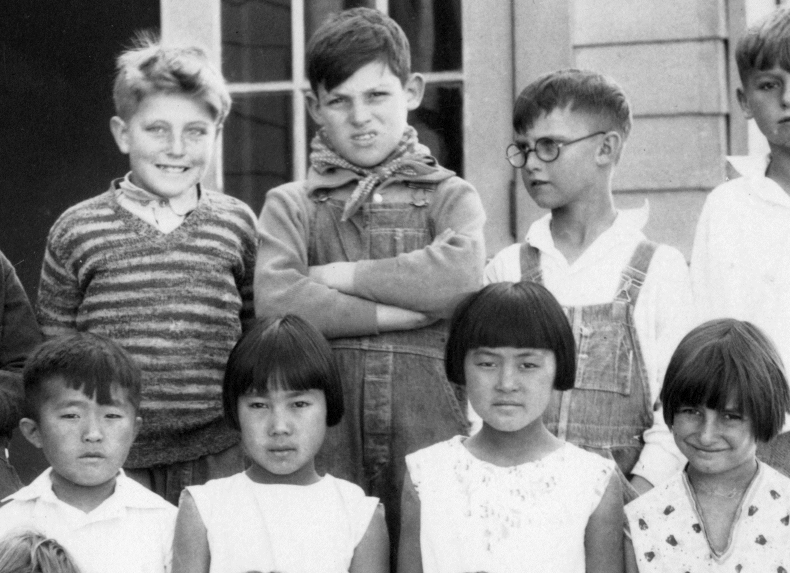
GAMUT OF EMOTIONS - A snip of the full image in the exhibit reveals the range of emotions on school picture day at Ocean View Grammar School.
(Photo courtesy of the Furuta family) © All rights reserved.


GRAMMAR SCHOOL DAYS: Farm children in the Smeltzer and Wintersburg Village areas (now both part of north Huntington Beach) attended the Ocean View Grammar School which was located at the southwest corner of Beach Boulevard and Warner Avenue (where the Comerica building stands today). Among the students in the photograph are children from the Furuta and Akiyama families, two of Wintersburg Village’s three goldfish farmers.  You can almost feel the anxious excitement of the children in this photograph, ready for the end of the school day when they can run back through the rural countryside to home.

Learn about Huntington Beach's unique pioneer history!
   Stop by the Main Street Library to see the full, original images from our pioneer settlement days!  Learn more about Historic Wintersburg at our sister blog, http://historicwintersburg.blogspot.com/

© All rights reserved.  No part of the Historic Huntington Beach blog may be reproduced or duplicated without prior written permission from the author and publisher, M. Adams Urashima.

Wednesday, December 19, 2012

Saving history: The Main Street Branch Library on Triangle Park in Historic Huntington Beach

ABOVE: Interior of the first library in Huntington Beach at Walnut and 3rd streets, circa 1913.  In a donated building, the library moved around a bit before finding a permanent home. (Photo, Huntington Beach Public Library)

   "From the beginning the Huntington Beach Public Library has been an illustration of citizen concern for the community and its future generations...some local organizations and the Huntington Beach Women's Club called a mass meeting on February 15, 1909, to form a library association."
                                                              History of Huntington Beach Public Library 

   Huntington Beach received a pre-holiday gift this year with our City Council's unanimous endorsement of the effort to list the Main Street Branch Library on the National Register of Historic Places.

   We took a look at the history of this little library--sited in a historic park--in August 2012, Historic Walking Tour #12 and #13: Main Street Library and Triangle Park,
http://www.historichuntingtonbeach.blogspot.com/2012/08/historic-walking-tour-12-and-13-main.html

   Establishing a library was one of the very first acts taken by early pioneers as they set about creating a community.   Huntington Beach was a dusty seaside town with unpaved roads, not much of a water or sewer system, and the entire community pitched in with whatever was needed.  It was a time of big dreams for the community and for the future of California.
   
ABOVE: At the same time residents were creating the first library, others were trying to harness the power of the ocean. See "Masters of the Ocean Waves" http://www.historichuntingtonbeach.blogspot.com/2012/05/masters-of-ocean-waves.html (Image, Los Angeles Herald, December 19, 1909)

   When early residents formed a library association, they enlisted the help of librarians from nearby Long Beach, paying their lunch and traveling expenses.  At the time the first library opened in 1909  "there were 338 volumes in the library, 228 were gifts while 110 had been bought new. The new library subscribed to twelve magazines..." (History of Huntington Beach Public Library).

    As the community grew, the need for library services grew, eventually leading to the opening of the Main Street Library on Triangle Park in 1952.  Today, Huntington Beach is lucky to have a Richard Neutra-designed Central Library, sited in Central Park.  This was another effort by the community to create centers of culture and learning for residents and future generations, just like the first effort in 1909 and all those in between.

Left: Interior of the internationally acclaimed Huntington Beach Central Library, designed by Richard Neutra, in the City's 350-acre Central Park.  The Central Library holds the largest children's library west of the Mississippi. (Photo from the Italian magazine, Architettura, vol. 22, no. 250-251, 1976)

      The effort to list the Main Street Library on the National Register of Historic Places is a call to action for both Huntington Beach newcomers and descendants of our farseeing pioneers.  The first step is to enlist the nominating support from the California Office of Historic Preservation.

By January 8, 2013, send a LETTER or EMAIL supporting the historic listing of the Huntington Beach Public Library at 525 Main Street to:

William Burg
State Historian I
Office of Historic Preservation
State of California  

1725 23rd Street, Suite 100
Sacramento, CA 95816

William.Burg@parks.ca.gov

 About the Main Street Library on Triangle Park:
   The Main Street Library, 525 Main Street, is sited in the original 3.57-square-mile townsite, which contains the National Register-listed Helme-Worthy Store and Residence (http://www.historichuntingtonbeach.blogspot.com/2012/08/historic-walking-tour-6-me-helme-house.html), Huntington Beach Elementary School Gymnasium and Plunge (1931), and Newland House (1898), as well as many locally designated and eligible properties.

   Five blocks north of Pacific Coast Highway, the property is near the historic site of the Huntington Beach Municipal Pier, surrounded by eclectic residential neighborhoods. As a neighborhood park including a number of nearly ninety-year-old palm trees, Triangle Park (1912) provides the setting for the 9,034-square-foot Main Street Branch Library (1950-1951), a locally designated City Landmark. 


   The Main Street Library was designed in the "International Style" of early post-World War II period of the Modern Movement. Municipal restoration efforts over the last 30 years have returned Triangle Park to an authentic mid-1920s period, and the park and library remain as both the earliest and latest components of the community's early Civic Center.

  National Historic Register criteria for listing include properties that embody a significant contribution to broad patterns of the City's local history, in the area of community planning and development, as well as properties representative of unique architecture. 

   Established as a recreational park in 1912, just three years after the incorporation of Huntington Beach, Triangle Park became part of the City's early-20th century Civic Center campus.  The Library's architecture represents the principles of postwar Modern design and the distinctive characteristics of site-cast, concrete tilt-up construction from the Mid Century  period, particularly that of public libraries. The Main Street Library is the work of masters, James Edward "Ted" McClellan, Denver Markwith, Jr., and Jack Hunt MacDonald.

A little mid-century inspiration. (Image, guardian.co.uk)

UPDATE: California Historical Resources Commission on February 8, 2013, voted unanimously (7-0) to recommend that the U.S. Park Service list on the National Register of Historic Places the Main Street Library on Triangle Park.  As of April 2013, we await word on the national listing.

All rights reserved.  No part of the Historic Huntington Beach blog may be reproduced or duplicated without prior written permission from the author and publisher, M. Adams Urashima.